
The past few years have been water’s moment. Nationally, we’ve had a greater recognition of the importance of water: an understanding that water really is life, and we need to invest in it. More money than ever poured into various funding programs to allow water and wastewater utilities to address needed infrastructure projects. Some of the money was “free”, mostly free, or with extremely favorable terms (very low or no interest rate for long time spans) for those communities who might struggle to pay back a loan. While accessing funding explicitly meant for water might seem simple, the process is not as straightforward for water systems as it might appear.
Introducing the Funding Pipeline to Success
If all you needed to do was ask for the money, it would be hard enough with applications and associated documentation. But, there are many more obstacles that can be put in your path. At the Southwest EFC, we developed the “Pipeline to Success” to describe the various steps you will need to go through, available soon on our website. Our organization can offer support through training technical assistance and provide online resources accessible by anyone at any time to help you through the journey.
The process of accessing funding may feel daunting, but if you start down the pathway and take a systematic, step-wise approach, you can achieve the best outcome for your community. The most important goal is to remember that your role as a water professional is to provide the desired service for your customers while protecting their public health and the surrounding environment. As much as we might want to think that this can be done at an extremely low cost, that is not the case. Delivering service costs money. Even if the new infrastructure project is completely free, there is still a need to operate and maintain the infrastructure. That part is not free and has to be paid for by the customers. It is important to communicate with customers 1) the value of water and relatedly, 2) the need to adequately fund the utility operations.
In fact, the best place to start the infrastructure journey is not on the technical side, but rather, on the financial side. To start off, it is important to ask yourself some probing questions:
- Have you been doing annual financial audits?
- Do they meet the requirements of the state you’re located in?
- What do they tell you about your financial position?
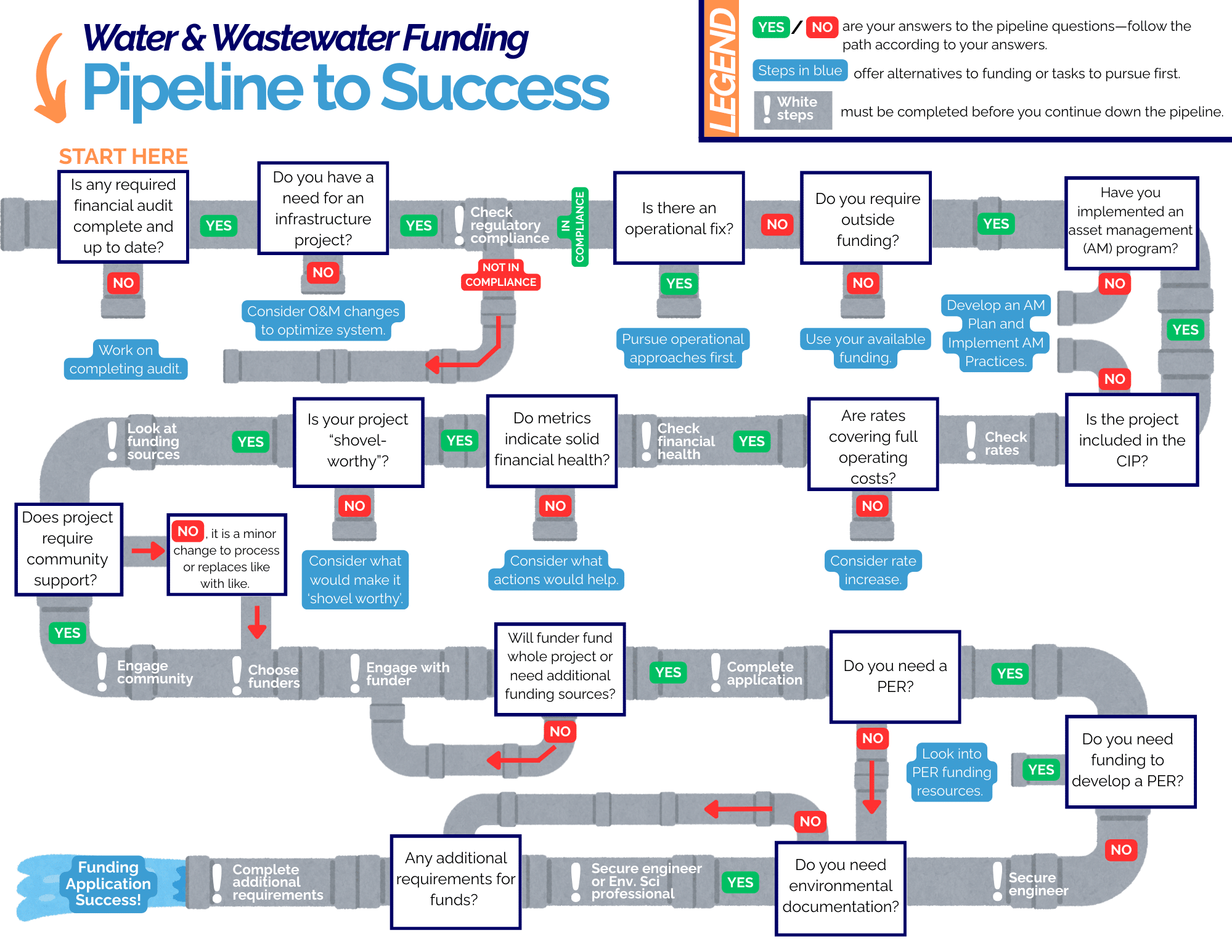
Depending on your particular system size, the state within which you’re located, your annual revenues, and whether or not you’ve recieved past funding, there may be different requirements regarding the financial audit. It is important to check the requirements of your state and make sure you are current. Otherwise, you will have a hard time moving forward in the funding process.
You will also need to review your rates and current financial health. You should review them annually and raise them as necessary to maintain positive financial metrics. It is also important to consider affordability and how best to help those customers who are unable to pay their water bill. Everyone needs access to drinking water and wastewater services, so it is important to find a solution that ensures the financial health of the water system while also taking into account the financial demographics of the community.
After examining the finances, it is important to understand the project clearly. Do you need an infrastructure fix, or could you use an operation and maintenance change? If you can solve the problem without spending infrastructure dollars, that may be the best approach.
Then you will need to determine whether you have a plan to manage the infrastructure you have right now(often called an asset management plan) as well as the infrastructure you will get in the future if you undertake an infrastructure project.
Once you decide you need a project, you will have to determine which funder is best suited to your community’s individual needs. You may also have to link up several sources of funding to get all the money you need or to fund individual portions of the project that may fit the criteria of one funder, but not another.
And finally, once the funder(s) have been identified, you will need to to complete all necessary portions of the required application process, such as engineering reports and environmental documents. These may vary between funding sources.
Conclusion
In this introductory blog, we’ve given a brief overview of the overall Pipeline to Success process. It is our intent to have a series of blogs that will discuss each part of the pipeline in greater detail and connect you with other resources that can help you along the way. We would like as many systems as possible to receive the help they need to ensure safe drinking water and wastewater treatment.
Stay tuned for additional discussions on the Pipeline, and for a link to the Pipeline homepage.