
Key Takeaways From Our Webinar: Green Schoolyards as a Stormwater and Community Resilience Strategy
This webinar is part of a three-part series on green schoolyards, which was presented by the Environmental Finance Center Network on June 16, 2026.
School grounds cover millions of acres across the United States – and most of them are paved. For anyone concerned about student health, community access to nature, or localized flooding and water quality, that’s a missed opportunity of enormous scale. Green schoolyards transform those hard surfaces into thriving, nature-rich spaces that manage stormwater, cool urban heat islands, support student health and increase green space access by opening their gates to surrounding communities after hours. For utilities seeking cost-effective ways to meet stormwater or green infrastructure goals, they may be one of the most promising, and underutilized, partners available.
A Holistic Solution, Grounded in Community
Danielle Denk of the Trust for Public Land (TPL) opened the webinar by framing green schoolyards not as a niche amenity, but as a cornerstone of equitable climate resilience. TPL’s Community Schoolyard™ model – built on nearly 30 years and close to 300 projects – prioritizes deep community engagement from the outset. Schools become neighborhood anchors, with green spaces that serve students during the day and neighbors on evenings and weekends.
“If all schools had a Community Schoolyard: 50,000,000 students and 80,000,000 community members would benefit from increased tree canopy, improved air quality, reduced temperature and reduced flooding.”
–Trust for Public Land
Denk illustrated the model’s reach through a rural and Tribal project example, demonstrating that this approach works across geographies and community types, not just dense urban districts. She also introduced attendees to TPL’s How to Create a Community Schoolyard toolkit, a practical resource covering planning, design, funding and long-term stewardship. The most durable projects build buy-in early and broadly – not just from school administrators, but from families, neighborhood associations and local government partners who will all have a stake in the space.
Practical takeaway: If you’re a utility or funder exploring green schoolyard investment, start by identifying school districts that have already begun community engagement around their grounds. Projects with existing momentum are significantly easier and faster to fund and more likely to succeed long-term.

The photos show the before-and-after green schoolyard transformation at E.M. Stanton School in Philadelphia, PA. Credit: Trust for Public Land
The Utility Opportunity
Jim Sparber of Greenprint Partners zeroed in on a funding avenue that remains largely untapped: utility grant programs. Stormwater utilities, water authorities and energy utilities across the country have programs specifically designed to fund green infrastructure on private and institutional land – and school campuses are ideal candidates.
Green schoolyards tick nearly every box utilities care about: they reduce impervious cover, manage runoff at scale, provide measurable water quality benefits and generate community goodwill. For utilities under regulatory pressure to meet Clean Water Act or MS4 permit requirements, partnering with school districts can be a smart, visible and community-beneficial path to compliance. This path also streamlines management, with a single point of entry (like a school district) to access a portfolio of properties to retrofit.
Sparber emphasized that the funding case is strongest when projects are framed around utility-specific metrics from the beginning – gallons managed, impervious area converted, combined sewer overflow (CSO) reductions – rather than retrofitted after the fact. Utilities that participate early in the planning process can shape project scope, ensure infrastructure meets grant criteria and build the documentation needed for compliance reporting.
Practical takeaway: Utilities don’t have to wait for schools to come to them. Proactively mapping school campuses within your service area against impervious cover data can quickly surface the highest-impact sites and make the case internally for a targeted green schoolyard grant program.
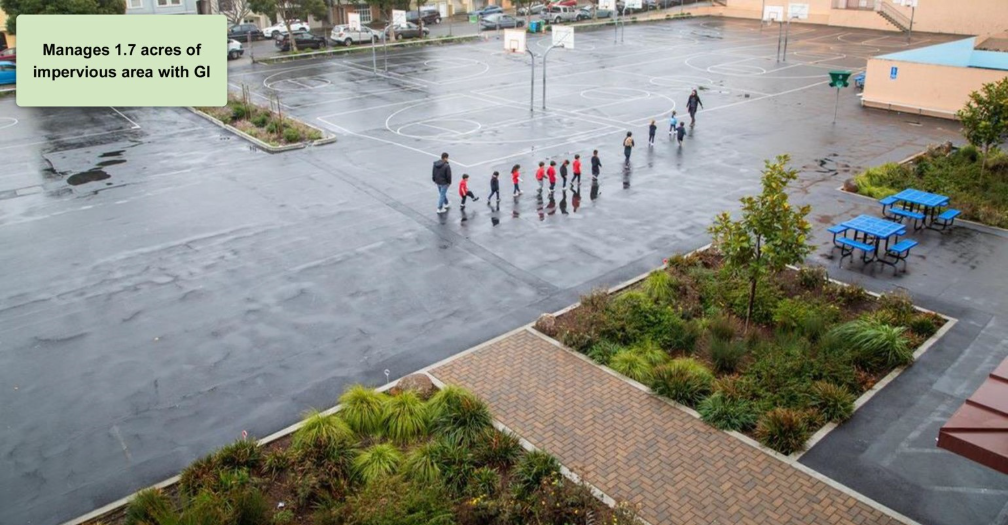
The dual-purpose schoolyard and parking lot at St. Anne of the Sunset in San Francisco, CA now manages 1.7 acres of impervious area with green infrastructure. The green infrastructure (bioswales, permeable pavers, rain gardens) was funded through the utility (San Francisco Public Utilities Commission), while the school fundraised for additional amenities such as the picnic benches. Credit: SFPUC
Three Actions to Take Now
1. Download the toolkit. TPL’s How to Create a Community Schoolyard is free and designed for practitioners. Whether you’re a utility evaluating grant criteria, a funder assessing project feasibility or a school district planning your first project, it’s the most practical starting point available.
2. Map your opportunities. Utilities and funders should identify school campuses within target watersheds or service areas, overlay impervious cover or flood risk data, and flag schools already engaged in greening efforts. This creates a ready pipeline of shovel-worthy projects.
3. Align your metrics early. The most fundable green schoolyard projects are designed with measurable outcomes baked in. Work with engineering partners to ensure stormwater volume, heat reduction and community access metrics are documented from day one. This will make grant reporting and compliance documentation far easier in the long-run.