
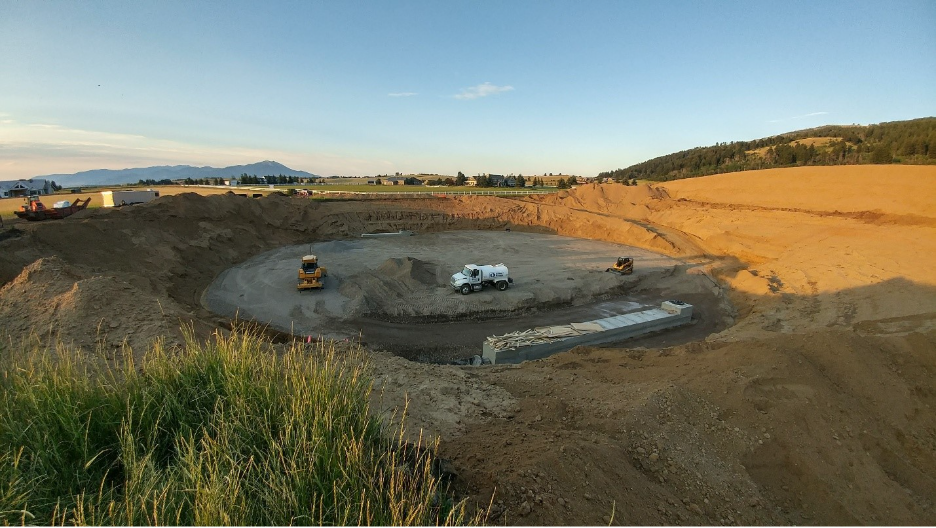
Photo credit: Tucker Colvin
There is currently a big need for infrastructure funding for drinking water and wastewater utilities. But for so many small and rural communities with limited staff, it can be hard to access funding. If you determine that your project requires outside funding, how do you get it?
Planning
You need to start with planning. With some exceptions, your project will likely require a Preliminary Engineering Report (PER), or similar type of document, before you can apply for the actual infrastructure funding. A PER is created by an engineer, in consultation with your operations and management staff, and assesses your current system, the various solutions to your needs, and a cost estimate of those alternatives. However, creating a PER isn’t free, so a small utility needs to determine how to afford the costs. There are many funding sources that specifically pay for planning documents, including state and federal sources that may be a grant or low interest/no interest loans. However, there are two potential issues:
- Some sources may require the system to front the costs and get reimbursed after expending the money, and
- The maximum award amount for many planning-specific funds has not kept up with the rising costs of document completion.
For example, completing a PER may cost up to $100,000, but some states provide funding far lower in amount, such as the North Dakota Department of Environmental Quality Planning Assistance Reimbursement that will only cover up to $15,000. At the federal level, the USDA Rural Development’s planning fund will cover up to $60,000 and up to 75% of total costs. Depending on the state and the type of project needed, completing a PER might require a combination of local, state, and federal sources to obtain sufficient funding.
Infrastructure Funding
Once a community has completed a PER (or similar document required by the funding source) and selected its project alternative, they are ready to apply for infrastructure funding. The infrastructure funding landscape can be very overwhelming for someone who is not familiar with it. Funding sources include federal, state, federal administered through states, and private funding; all administered through different agencies with varying rules and timeframes. So how does one start to figure out what is best for their community? There are three good ways to start. First, if your state has a coordinated funding committee of some type (such as the Arkansas Water and Wastewater Advisory Committee or the Texas Infrastructure Coordinating Committee) this group likely contains all or most of the state and federal funding sources for water and wastewater and can review your project and provide information regarding potential funding sources. The Environmental Finance Center Network (EFCN) has written blog posts for each of these programs and links can be found at the end of this blog, along with links to other blogs on related topics. Each one of these committees works a bit differently, but usually a system can appear before the board and seek guidance regarding which funding sources might be able to fund their project. Second, if you already have an idea where you plan to access funding, you can contact that agency directly, and they will likely have resources to help you complete the process. Third, there are several technical assistance (TA) providers that can provide free help with the process, such as the Environmental Finance Center Network.
A list of funding sources for states, territories, and tribes is available on the EFCN website. However, this list may not include single-time sources, local/regional sources, or funds not as directly associated with water infrastructure that may be able to be creatively applied to your project. Some individuals helping systems may be more familiar with certain funding sources over others, so it can be helpful to reach out to additional resources or other TA providers to get additional information on potential funding sources.
Once some potential funding sources are selected, it is important to reach out to the people administering the programs and set up a meeting to discuss the process. Although they may not be able to give you suggestions on how to make your application more competitive (if it’s a competitive grant), they can give you more information about the requirements, deadlines, and grant administration responsibilities to help you get through the process and make informed decisions about the best approach for your overall funding package.
Application Process
Each funding source has its own specific requirements which vary considerably from agency to agency. As an example, the Drinking Water and Clean Water State Revolving Funds require projects to be placed on the state’s Project Priority List, which is updated annually. The projects are selected based on project prioritization criteria which are unique to each state. There may be additional state-specific application requirements, so it is important to check with the agency to find out what these requirements are.
Individual funding applications may be a series of questions answered in an online form or may require a project narrative with specific sections and a page limit. If the application has a scoring rubric, which is common for state revolving funds and other competitive funds, it is important to ensure that your narrative appropriately considers and incorporates the weight of each rubric requirement. It can be helpful to have someone else, such as a TA provider, go through your narrative and review it based on the rubric to see how well you addressed each item. This information can be used to see if you should adjust the application prior to submittal. Understand, however, that an outside reviewer is only able to provide their opinion of what an agency reviewer might think and cannot know the exact score an agency would give the application.
Most applications are submitted directly to the funding agency. Sometimes, single-occurrence and unique federal funding opportunities are submitted through grants.gov and described in the fund’s associated Notice of Funding Opportunity (NOFO). These programs are generally one-time, non-recurring funding sources, unlike the state revolving funds, so they are potentially available at one time when you search but may not be available another time. You can use grants.gov to search for funding opportunities directly, but it’s often better to find the agency’s website for a specific fund, which includes the link for the grants.gov application, as well as other useful information on the program. Before applying for federal funds, make sure your organization has a Unique Entity Identifier (UEI) and an account with SAM.gov. It may take months to acquire these if you don’t already have them.
Strategies
If your project is a large dollar amount, includes unique elements, or requires a considerable grant portion to make it affordable, you will likely require a combination of funding sources to complete the overall project. This package may include a combination of grants, loans, and/or local match requirements. Sometimes, funds can be used as matches for each other but, as a general rule, federal sources cannot be used as a match for other federal sources. There can be some exceptions, however, so be sure to contact the funding agency for its specific rules and requirements. Some states, such as New Mexico, have grants that are specifically designed to act as matches for federal funding, so consider taking advantage of these funds, when available, in order to minimize the impact of construction projects on rate payers.
If your project is very large dollar or your user base is very small, it may be necessary to break the project into phases to enable the whole project to be completed, but over a longer period of time. This additional time may enable the funding sources to provide more overall funding, a higher grant portion overall, and reduce the rate shock on customers. It may also give the utility more ability to provide support to the project. A very large construction project can overwhelm a small community and doing the project in smaller segments may help.
Getting an infrastructure project from concept to completion can be an overwhelming process. But there are many people who have already gone through the process that can help guide you. These individuals may be TA providers, engineering firms, representatives from councils of governments or county agencies, or the water/wastewater utility in the next town over. Be sure to utilize this expertise. Talking to people, whether it be the staff of the funding agency itself or experienced helpers, can often make a big and overwhelming process seem much more doable.