
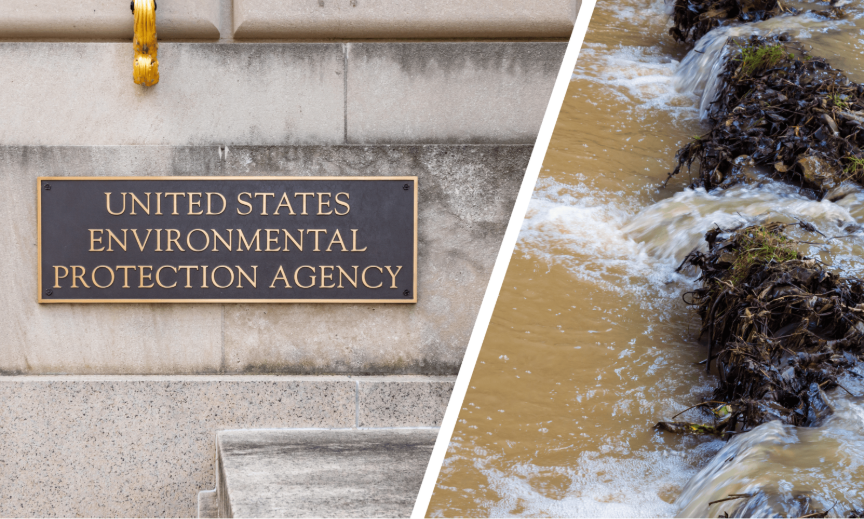
Photo credit: Clean Water Action (2025).
The Clean Water Act (CWA) has served as the cornerstone of water quality protection in the United States for over five decades. Originally passed in 1948 as the Federal Water Pollution Control Act, the law was substantially amended in 1972 to establish its primary goal: to “restore and maintain the chemical, physical, and biological integrity of the Nation’s Waters.” However, proposed changes from the U.S. Environmental Protection Agency (EPA) could significantly reshape the regulatory landscape, with direct implications for small water systems and the communities they serve.
What’s Being Proposed?
On November 17, 2025, the EPA and the U.S. Department of the Army published a proposed rule to revise the definition of “Waters of the United States” (WOTUS) under the Clean Water Act. WOTUS is the legal term that determines which waterbodies, rivers, streams, wetlands, and lakes, fall under federal jurisdiction and receive protection from pollution and development.
The proposed rule would strictly narrow the WOTUS definition, limiting federal protections to “relatively permanent” waters, those that are standing or continuously flowing year-round or at least during a “wet season”, and wetlands that have a “continuous surface connection” to such waters. Seasonal streams, ephemeral waterways, and isolated wetlands would largely lose federal oversight.
Key Changes at a Glance
- Narrower tributary definition: Only streams with year-round or steady wet-season flow would qualify for protection.
- Wetland protections reduced: Wetlands must physically touch (abut) a jurisdictional water body and maintain surface water at least during the wet season.
- Interstate waters removed: Water features crossing state lines would no longer automatically qualify as WOTUS.
- Expanded exclusions: Ditches, prior converted cropland, waste treatment systems, and groundwater would be more clearly excluded from federal jurisdiction.
- Undefined “wet season”: The rule requires surface hydrology to be continuous during the “wet season” but does not define what that term means, which could cause uncertainty, particularly in arid and semi-arid regions.
Why This Matters for Small Water Systems
Small water systems often depend on headwater streams, seasonal tributaries, and wetlands as source water, precisely the types of water bodies that may lose federal protection under the proposed rule. According to the Southern Environmental Law Center (SELC), without federal oversight, upstream pollution becomes harder to prevent, potentially driving up treatment costs and compliance burdens for small systems already operating on tight budgets.
Estimates suggest that this rule could remove federal protection for approximately 80% of the nation’s remaining wetlands. Wetlands serve as natural filtration systems and flood buffers, services that directly benefit small water systems and the communities they serve.
Additionally, the proposed rule shifts greater responsibility to states and tribes to regulate waters no longer covered federally. However, state-level protections vary widely, and in some cases, states have actually weakened protections in response. For example, the North Carolina General Assembly passed a law eliminating a state gap-filler, decreeing that only wetlands meeting the narrower federal test would receive state protection. For small systems operating in states with weaker protections, this could mean greater vulnerability to upstream pollution with fewer avenues for recourse.
What Small Systems Can Do Now
- Stay informed. The 45-day public comment period closed on January 5, 2026, and the EPA is expected to adopt a final rule in spring 2026. Monitor developments through the EPA’s WOTUS webpage.
- Understand your source water. Assess whether your system’s source water includes headwater streams, seasonal tributaries, or wetlands that may be affected by the narrowed definition.
- Engage with state regulators. As federal jurisdiction narrows, state-level protections become more critical. Engage with your state environmental agency to understand what protections will remain in place.
- Leverage technical assistance. Federal and state technical assistance programs can help small systems evaluate source water risks and plan for potential changes.
- Connect with your network. Organizations like the American Water Works Association (AWWA), the National Rural Water Association (NRWA), and your state rural water association can provide updates and practical guidance.
Conclusion
The proposed WOTUS rule represents one of the most significant shifts in federal water regulation in decades. For small water systems, the stakes are high. Clean source water is the foundation of safe, affordable drinking water service. Staying engaged, understanding the changes, and proactively planning are the best steps small systems can take to protect their communities.