

This blog is tailored for state and local officials, municipal planners, stormwater practitioners, and community leaders who are evaluating or implementing green infrastructure. Understanding the design and functions of bioswales will empower stakeholders to make informed decisions about local water quality initiatives, justify budget allocations for green infrastructure, reduce runoff and effectively meet regulations.
What is a bioswale?
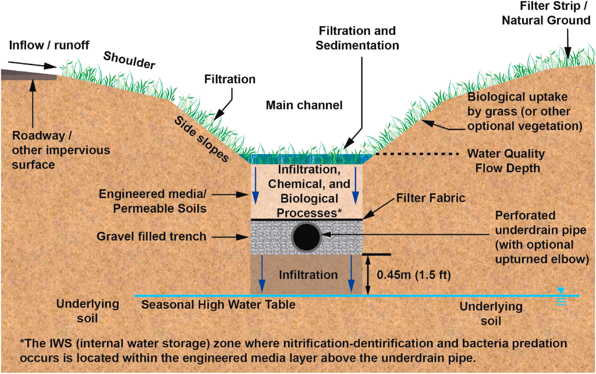
Bioswales are vegetated, shallow, landscaped channels designed to concentrate and convey stormwater runoff while removing debris and pollution. They use native vegetation, mulch, and engineered soil to slow, infiltrate, and filter water, acting as a sustainable alternative to traditional concrete storm sewers. Bioswales are designed to manage runoff from smaller impervious areas like streets and parking lots.
Bioswale Functions
- Conveyance & Filtration: Bioswales gather rainwater from impervious surfaces (roofs, roads) and filter out sediments, nutrients, and heavy metals through soil and plant roots.
- Infiltration & Slowing Water: The gentle slope (ideally 3:1), vegetation, and check dams (small rock dams) slow down the water flow, encouraging it to absorb into the ground rather than rushing directly into waterbodies or storm sewers.
Bioswale Design
The following design elements represent the foundational criteria that practitioners should evaluate during the planning phase to ensure proper functionality of a bioswale.
- Drainage Area Limits: Target small areas (typically < 1 acre) and for larger areas, pivot to wet/dry swale variations to handle higher pollutant loads.
- Slope Optimization: Ideal gradient is 1% to 2%, if the site is steep, incorporate check dams to slow velocity and prevent erosion.
- Soil Evaluation: Assess hydrologic soil groups during design. Target Group A and B soils. Groups C and Group D are usually not suitable depending on site conditions.
- Engineered Soil Mix: They often feature a combination of sand, compost, topsoil with little clay and are designed to hold water while allowing infiltration, ideally draining within 24–30 hours. Check local or state requirements (Department of Public Works or Environmental Protection) about soil mix suggestions.
Runoff Reduction Potential
Bioswales are highly effective at reducing urban stormwater runoff volume by 44% to nearly 99% during typical rain events, with some studies showing average reductions of approximately 89%. Depending on where you are located, the bioswales can hold 7.48 gallons/sq ft and reduce runoff by 17 gallons/sq ft. The table shows an example of runoff reduction in a small storm event from a 500 sq-ft bioswale installed in a 5,000 sq-ft parking lot.The simple and SCS methods show approximately 5500-5900 gallons of runoff reduced by up to 43% with the bioswale.
Table: Bioswale runoff reduction calculations with simple and NRCS method. Exact numbers will vary depending on location, soil and plant type and other geographical features.
| Simple Method | SCS (NRCS) Curve Number Method* | ||||
| Variable | Value | Unit | Variable | Value | Unit |
| Parking Lot Area | 5000 | sq ft | Parking Lot Area | 5000 | sq ft |
| Rainfall | 2 | in | Rainfall | 2 | in |
| Runoff Co-efficient | 0.95 | Curve Number | 98 | ||
| Runoff Volume | Runoff Volume | ||||
| Total Runoff Volume | 791.67 | cubic ft | Soil Storage | 0.204 | in |
| Total Gallon | 5922.08 | Gallons | Runoff Depth | 1.80 | in |
| Total Runoff Volume | 748.30 | cubic ft | |||
| Total Runoff Volume | 5597.7 | Gallons | |||
| Bioswale of 500 sq.ft with 6 inch depth | Bioswale of 500 sq.ft with 6 inch depth | ||||
| Surface Ponding | 250 | cubic ft | Surface Ponding | 250 | cubic ft |
| Filter media | 75 | cubic ft | Filter media | 75 | cubic ft |
| Total Capture Potential | 325 | cubic ft | Total Capture Potential | 325 | cubic ft |
| Total Capture Potential | 2431.17 | Gallons | Total Capture Potential | 2431.17 | Gallons |
| Stormwater Captured | 41% | Stormwater Captured | 43% | ||
*NRCS method also accounts for soil type which can be important consideration for green infrastructure design
Bioswale Pollutant Load Reductions
Bioswales not only reduce runoff but also reduce pollutant loads. Plants and their root systems absorb nutrients such as nitrogen and phosphorus from the soil and water to support their growth and soil microbes break down organic pollutants and facilitate denitrification. Suspended particles containing attached nutrients are filtered out as water slowly filters through the vegetation and into the soil media. Nutrients are trapped within the engineered soil, mulch, and gravel layers. Pairing bioswales and infiltration basins can also be useful for MS4 permits and help in compliance with minimum control measures around Illicit discharge detection and elimination.
Cost and Maintenance
Installation costs vary significantly based on whether you are building a simple grass swale or a highly engineered bioswale with special soil. According to the Green Values Stormwater Management Calculator a bioswale of 500 sqft. will have an initial cost of $8,790 and annual operation and maintenance cost of $130. And it can filter nearly 2,120 gallons of water for small, more frequent storm events. Bioswales are generally considered long-lasting, with effective lifespans in the range of 20 to 30 years.
Further Resources
- What is a Biofiltration Swale?
- Grassed Swales
- Vegetated Swales/Dry Swales
- Green Values Stormwater Management Calculator
- CLASIC – a tool for estimating the performance and lifetime cost of green infrastructure.