
Protecting your source water is one of the most important ways to protect public health. When it comes to the money, many utilities run into the same problem: there are a lot of funding programs out there, and it can be hard to know where to start and what you could be eligible for.
Enter the Environmental Protection Agency’s (EPA) Funding Integration Tool for Source Water (FITS).
Let’s Be Clear on What “Source Water” Means
Source water is raw untreated water which is currently being used, or will be used, for potential drinking water—think rivers, streams lakes, reservoirs, springs and groundwater.
Source water protection is any action or activity that protects, maintains, or improves the quality and/or quantity of water and the land areas that drain to them.
What is FITS?
The Funding Integration Tool for Source Water (FITS) is an interactive web tool developed by EPA to help users understand:
- What funding is available
- How funding can be used at different stages of source water programs
- How different funding can fit together over time
- Examples of how funding has been (or could be) used
If you’re bored already, and want the information faster, EPA provides this quick, two-page overview of FITS that summarizes the tool and its key features.
Who should use it?
Anyone who is involved in protecting drinking water sources. This can include:
- Small drinking water systems
- Wastewater utilities
- Tribal utilities
- States, Tribes, territories
- Federal agencies
- Watershed groups and other local partners
FITS is a great resource to understanding what funding is out there, and how it could apply to protecting your source water, especially for organizations with limited staff and capacity.
How is it organized?
The system essentially feels like navigating a guided presentation. Its sections are linked with each other to make it easy to move between funding programs, planning steps, and examples. Some terms are underlined so users can hover over them to see definitions. There is also a glossary included that explains common funding terms.
For users who prefer a printable or offline reference, EPA also provides a PDF version of the FITS content that mirrors what is on the website.
When you first enter, there will be a couple tabs showing how to use the tool, as well as an introduction to what it does. Once you get to the main page, it is organized into three main sections:
- Funding Sources for Activities that Protect sources of Drinking Water
- Planning and Funding Coordination
- Examples
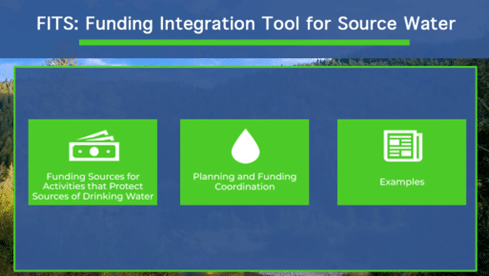
Below is a deeper dive into each section and how it can be useful.
Funding Sources for Activities That Protect Sources of Drinking Water
This section provides an overview of the 14 federal funding programs available as of January 2026 (9 EPA programs, 5 from other agencies). EPA has been adding programs over time which makes this a helpful resource to see everything in one place.
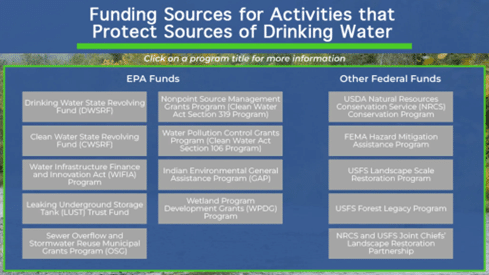
When you click on one of the funds, the “Drinking Water State Revolving Fund (DWSRF)” for example, it opens a new page with tabs that break down the program including details such as:
- What the program is
- How funds can be used
- Who is eligible
- Annual funding information
- Funding structure and limitations
- Additional program details and links
This can give a good overview of eligibility and fund uses upfront, which can help users see whether a program might support their activities before spending time on a full application.
Planning and funding coordination
There are two major phases to a source water protection program: the assessment phase and protection phase. The FITS tool breaks these two phases down into smaller steps, connecting funding sources to the steps involved in a source water protection program:
- Assessment phase
- Delineate source water areas
- Inventory potential contaminant sources
- Determine susceptibility
- Engage the public
- Protection Phase
- Develop an action plan
- Implement protection activities
- Evaluate and update efforts
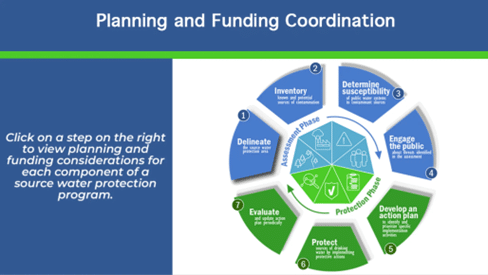
When you click on one of the steps, “Delineate” for example, it will open a new page with tabs related to that part of the phase:
- Overview of activity
- Funding sources that could support the step
- Planning considerations to improve future funding eligibility
- Links to examples
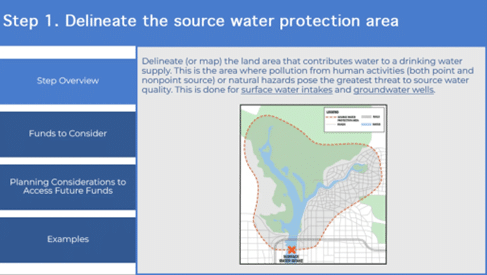
This section can be helpful to see how programs can support different steps of a larger effort. Looking at the funding this way can be useful if the work needs to spread over multiple years or if it can work in conjunction with other programs.
Examples
The last section of FITS is the examples section. This section organized by funding source (a specific program) or by program component (specific source water activities).
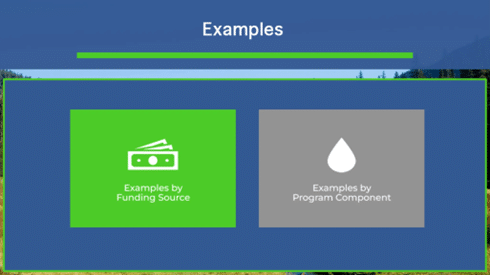
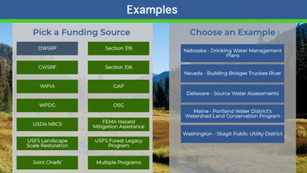
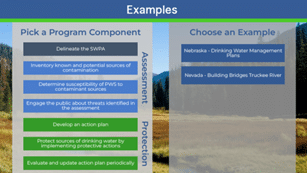
Users can click on an example to read more details. When real-world examples are limited, FITS includes scenarios that help users understand how funding could be used.
Final Takeaway
FITS isn’t going to make you an expert in federal funding, but it is simple to navigate and gives you a good starting point to become familiar with available funding, understand how programs can work together, and plan your next steps.
Using this tool, hopefully you can go from feeling overwhelmed to finding an approach that actually FITS.