

Trying to troubleshoot a problem? Maybe you’re not getting the desired coagulation or your chlorine dosage is lower than what you expect. The issue may be your chemical feed pump.
Real World Water Treatment Plant Example: The Problem
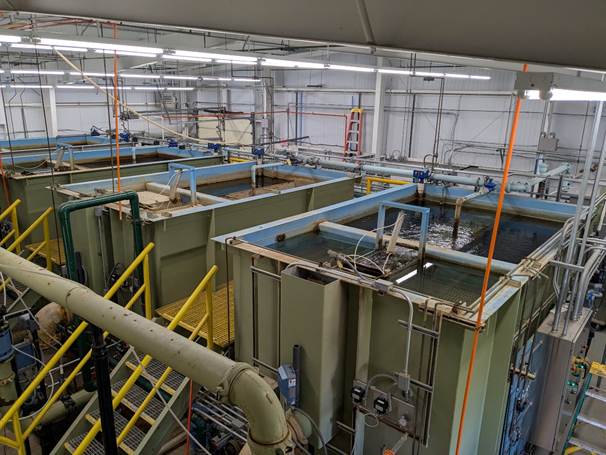
Recently, I visited a drinking water treatment plant that was using three treatment trains consisting of coagulation, flocculation, and filtration. After a night of heavy rain increased the raw water turbidity, two treatment trains were still functioning as intended, but one train experienced unacceptably high effluent turbidity. Why were two trains performing well while one dropped way off?
© Tucker Colvin, SW EFC
Troubleshooting
Preliminary Check of Pumps
To try to diagnose the issue, we started with a preliminary check of the chemical feed pumps. The diaphragm and peristaltic feed pumps for the two different types of polymers used in the treatment process seemed to be functioning properly.
Jar Tests
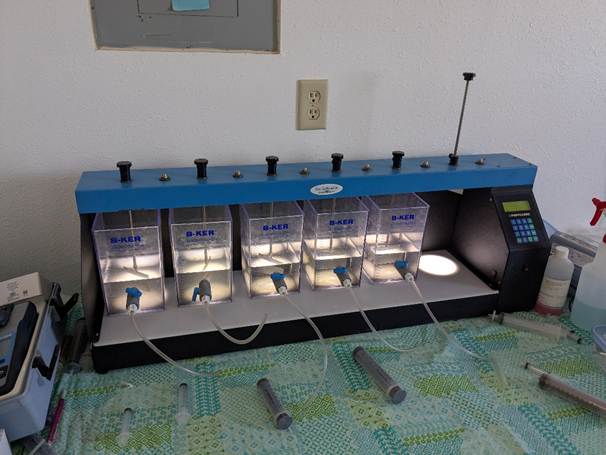
Next, to ensure we had the best coagulation and flocculation process, we performed jar tests. This included repeating the jar test twice, using two different polymer coagulants that are injected at different points in the treatment process, the first for sedimentation and the second for filtration.
© Tucker Colvin, SW EFC
Determining Feed Rate
After determining the desired dosage of both coagulants, we then needed to figure out the volume to feed into the water, known as the feed rate. In this case, the distributor of the polymers made a specific chart to show how the dosage could be converted to feed rate in milliliter per minute (mL/min), using the chemical’s density and purity. If your system does not have such a chart from the chemical distributor, there is a feed rate formula that can be used:

In this formula:
The dosage is what was just determined through the jar testing.
The flow in MGD (million gallons per day) is the amount of water going through the plant or each treatment train. (If you measure flow in some other units, such as gallons per minute, you will need to convert that value into MGD.)
The constant, 8.34 lb/gal, is the weight of water.
Purity refers to the percentage of a chemical that is the functional component of that chemical. However, if you determined the dosage based on the milliliters of that chemical added to each jar in the jar test, this value can be ignored.
After determining the feed rate in lb/day, you will likely want to convert to mL/min. Here are the conversion factors to use. The density of a chemical should be displayed on the container holding the chemical or in the associated Safety Data Sheet (SDS).

In this particular utility, the first polymer chemical feed pump discharged into the raw water before the water was split into three different trains. This pump was a diaphragm chemical feed pump, which is also referred to as a metering pump. The operator had previously calibrated this feed pump, so he was able to estimate how many mL/min would be pumped based on each pump setting. After setting the pump to the desired reading, we performed a drawdown test to ensure the pump was delivering the correct amount. The term “drawdown” refers to observing how quickly the surface of a liquid decreases when the pump is pulling the liquid out.
Performing a Drawdown Test
To perform the drawdown test, we filled a 1-liter graduated cylinder with water. We then took the suction end of the pump tube and placed it into the graduated cylinder. We started a stopwatch to time the pump for 1 minute and observed the reading on the graduated cylinder at the end of that minute. In this case, the amount of water pump was what was expected so that pump was performing as desired.
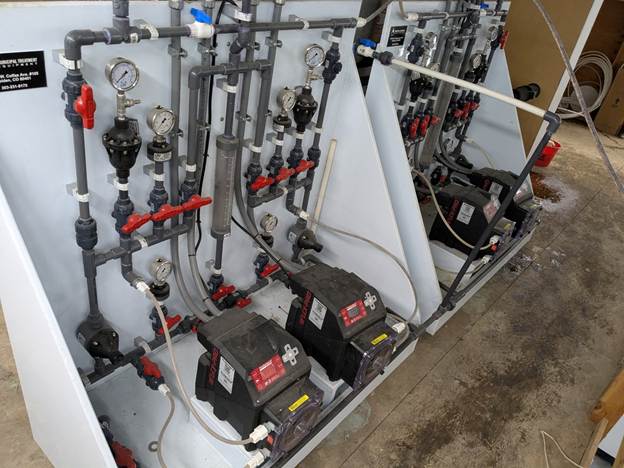
Next, we turned our attention to the three peristaltic feed pumps that add coagulant immediately before entering the filters. These feed pumps had digital read outs, so the pumps could be set to the desired mL/min. These pumps conveniently had calibration columns installed into the plumbing, meaning that we did not have to take the suction tube out of the chemical tank and use a separate graduated cylinder, we could just adjust a few valves so that the pumps would draw from the calibration tubes instead of the chemical tank.
© Tucker Colvin, SW EFC
The first two pumps were pumping as expected. Then we started the third test. The head of the peristaltic pump was rotating, but no chemical was pumping. We primed the pump, which for a peristaltic feed pump means that the head rotates very quickly for a period of time in order to increase the pressure to ensure the tubes are filled with liquid. During the priming, a significant amount of chemical was pumped from the column. The drawdown test was repeated under regular pumping conditions, but there was no drawdown.
The Solution
We theorized the issue with the pump was a pinhole leak in the tube inside the peristaltic pump. We replaced the tube, primed the pump, and repeated the drawdown test. This time the pump delivered the expected rate.
In this situation, replacing the tube in the peristaltic feed pump fixed the issues of poor filter performance; the high effluent turbidity was caused by the lack of coagulant in that filter.
Why Systematic Troubleshooting is Important
Sometimes in water treatment, the issue can be something simple, such as a hole in a tube, but other times, the problem may be more involved or there may be even more than one problem. In any case, the process to identify the issue should be systematic and undertaken carefully to ensure that any and all deficiencies in the system can be identified and corrected. This process may take a while, so it is important to be patient and take any intermediary steps necessary to protect water quality, such as taking a treatment train off-line temporarily or shutting the system down for a while and running off a storage tank while the investigation takes place.
In this scenario, it might be tempting to only focus on the poorly performing treatment train, but the change in raw water quality, which caused the issue, means that the better approach was to investigate the whole treatment process from start to finish to ensure that all the treatment trains were working properly and that there were no other deficiencies in the system. This systematic approach allowed us to determine the reason why one train was not functioning properly.
Additional Drawdown Testing Applications
Performing a drawdown test helped to troubleshoot this treatment issue, but there are other reasons to perform such a test, including ensuring that your peristaltic pump digital readout is correct for the type of tube or pump head that you are using. If you are using a pump that doesn’t have a digital readout, such as a Stenner peristaltic pump or a diaphragm pump, you can perform drawdown tests to determine the pumping rate of each pump setting. This is referred to as calibrating your feed pump.
If you need some guidance performing any of the tasks described in this blog, please reach out to the EFCN for assistance.