
Every time it rains, water sweeps across our roads and highways and carries whatever it finds into the nearest stream, river or estuary. Among the pollutants riding along is one that many municipal and utility staff are only beginning to hear about: 6PPD-quinone, or 6PPDQ.
Our webinar, Cleaning Our Waterways: Green Infrastructure Solutions for 6PPDQ, brought together experts from The Nature Conservancy, the Washington State Department of Transportation, Herrera Inc., and Stewardship Partners to explain the problem and, more importantly, what communities can do about it. Greenprint Partners’ Katie Harris moderated.
What 6PPDQ is, and Why it Matters
6PPD is a chemical added to tires to keep them from cracking and to extend their life. When it reacts with ground-level ozone, it transforms into 6PPDQ, which settles onto roads as tire dust and washes into waterways with the next storm. Kate Sievers of The Nature Conservancy did not mince words about its potency: “It’s the second most toxic chemical known to aquatic life.” Coho salmon and coastal cutthroat trout are especially vulnerable, and the chemical has now been detected in human urine, blood and breast milk as scientists continue to study its effects.
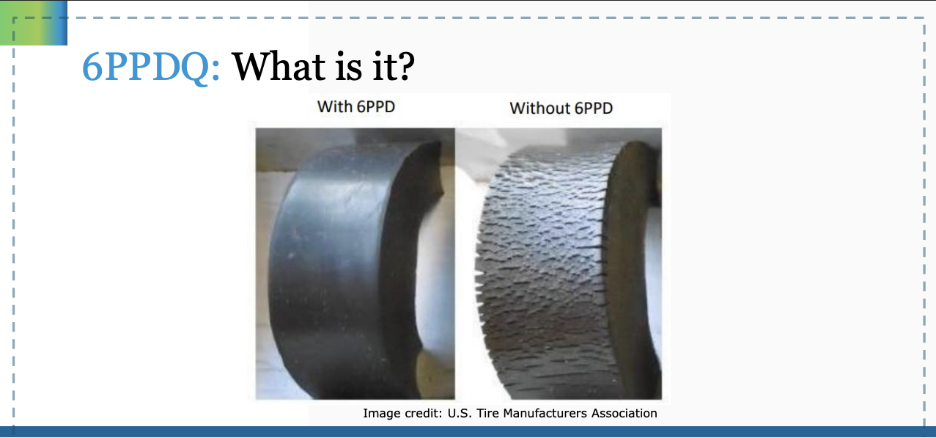
6PPD is a chemical added to tires to keep them from cracking. (Credit U.S. Tire Manufacturers Association via The Nature Conservancy)
The scale is easy to underestimate. Sievers noted that a single acre of pavement can send a million gallons of polluted water into Puget Sound each year, and that small and mid-size communities are far from immune. In small streams that catch the “first flush” of a rainstorm, concentrations can climb to lethal levels quickly.
A Proven, Affordable Solution
The encouraging news is that a workable solution already exists. Speakers described the “Box of Rain,” a non-proprietary bioretention system installed beneath elevated roadways where tire dust is heaviest. Runoff is routed through a filtration media of gravel, coconut coir and biochar before returning to the storm drain. In field testing under Washington’s rigorous TAPE protocol, the boxes cut 6PPDQ concentrations by roughly 75 percent while also removing dissolved copper and zinc — and, as Herrera’s Dylan Ahearn pointed out, pollutants “we don’t even know about yet.”
Just as important as the technology is who maintains it. Through its Adopt-a-Downspout program, Stewardship Partners engages local community groups to check the boxes monthly during storm season, giving residents a hands-on connection to clean water. Some sites even feature artwork from nearby high schools.
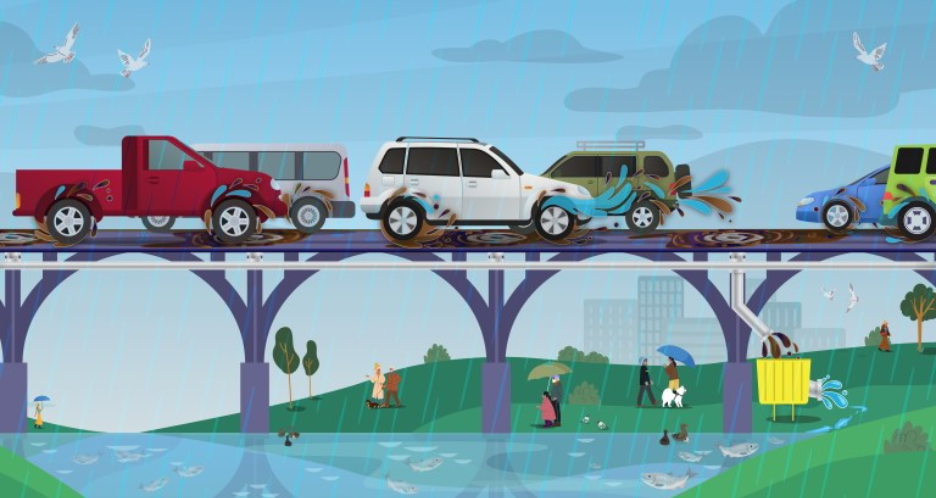
Box of Rain filters polluted stormwater from elevated bridges and roadways before it flows into storm sewers or the water below. (Credit: Stewardship Partners)
Practical Lessons for Local Agencies
Two challenges stood out for cities and utilities. The first is money. When webinar participants were polled, funding topped the list of barriers to green stormwater infrastructure. The second is partnership, which is often the answer to the first. Tony Bush of the Washington State DOT described tools his agency created to let cities, tribes, nonprofits and even concerned residents help fund and host projects on state land. His advice was direct: “if funding is an issue, there are other willing entities that would like to help.”
The Path Forward
For municipalities and utilities encountering 6PPDQ for the first time, the way ahead is clear enough to start now. Source-control regulations that phase the chemical out of tires will take years, even decades, to clean up what is already in the environment. Green stormwater infrastructure, bioretention, rain gardens and systems like Box of Rain, can begin intercepting the pollutant with the very next storm, protecting fish, waterways and the communities that depend on them.
The message is ultimately a hopeful one: the problem is serious, but the solution is within reach for communities of every size, especially those willing to build partnerships and put shovels in the ground.
Additional Resources:
EFCN Podcast | Cleaning Our Waterways: Green Infrastructure Solutions for 6PPDQ