


Photo by Adobe Stock
To address mounting concerns over the presence of PFAS (per- and polyfluoroalkyl substances) in the nation’s drinking water, EPA adopted the nation’s first PFAS National Primary Drinking Water Regulation (NPDWR), effective April 2024. This rule established maximum contaminant levels (MCLs) – legally enforceable limits – for six PFAS compounds.
This regulation is a major step forward in protecting the public from the harmful effects of these human-made “forever chemicals,” which break down extremely slowly in the environment and have been linked to a host of serious health concerns.
To comply with the NPDWR, water systems are required to conduct initial and ongoing testing for the presence of PFAS in drinking water. The first set of initial monitoring results is due April 2027 – less than a year away. Below is a rundown of what systems need to know about the PFAS monitoring requirements.
Regulated PFAS and MCLs
While the NPDWR initially applied to six PFAS compounds, an announcement by EPA last month expressed the agency’s intent to reevaluate MCLs for four of these, while affirming its commitment to keep existing regulations for PFOA (Perfluorooctanoic Acid) and PFOS (Perfluorooctane Sulfonic Acid). The MCL for both of these is 4.0 parts per trillion, which is equivalent to 4 drops of food coloring diluted in 20 Olympic-sized swimming pools.
Systems subject to PFAS NPDWR
The PFAS regulation applies to community water systems and non-transient non-community water systems. It does not apply to transient non-community water systems, such as gas stations or campgrounds. EPA estimates that approximately 6-10% of public water systems in the US, roughly 4,000-6,700 systems, will need to take action to reduce PFAS levels to meet the MCLs.
Monitoring timelines
Initial monitoring must be completed and submitted to primacy agencies (the state agencies that enforce and implement drinking water regulations) by April 26, 2027. After that point, compliance monitoring begins. The compliance deadline – when systems must ensure that drinking water does not exceed MCLs for regulated PFAS – is currently set for April 2029. However, a new rule proposed by EPA in May 2026 would allow water systems to apply for a two-year extension of the deadline, pushing to 2031.
Sampling locations and conditions
Samples must be taken at all entry points to the distribution system, collected during normal operating conditions. Consecutive interconnections are not considered entry points. If a water system draws water from more than one source and the sources are combined before distribution, the water system must sample at an entry point to the distribution system – again during a period representing normal operating conditions.
Sampling methods
Systems must use approved analytical methods when sampling for PFAS – specifically, EPA Method 533 and EPA Method 537.1 Version 2.0. Further, samples must be analyzed by an EPA- or state-certified lab. For more details on EPA-approved sampling methods, see the EFCN blog post “A Guide for Water Operators Preparing for PFAs Sampling and Regulations.”
Monitoring frequency
How frequently a system is required to monitor depends on its water source and how many people it serves. Surface water systems and groundwater systems serving more than 10,000 people must conduct four samples per twelve-month period, with samples taken 2-4 months apart. This schedule also applies to systems using groundwater under the direct influence of surface water (GWUDI), systems that use a blend of surface and groundwater, and systems whose water source changes seasonally. Smaller groundwater systems serving fewer than 10,000 people must take two samples per year, with samples taken 5-7 months apart.
Table 1. Required Frequency for Initial Monitoring
| System type | System size | Minimum monitoring frequency | Sample location |
| Surface water | All population sizes | 4 quarterly samples per 12-month period, taken 2-4 months apart | Each entry point to the distribution system |
| GWUDI | All population sizes | ||
| Groundwater | > 10,000 | ||
| Groundwater | ≤ 10,000 | 2 samples per 12-month period, taken 5-7 months apart | Each entry point to the distribution system |
Reporting requirements
Monitoring results must be submitted to state primacy agencies. In addition, if a system discovers PFAS levels exceeding the MCL, it is required to notify its customers. This public notification must include: the specific PFAS levels detected, the potential health risks associated with PFAS contamination, and the steps the system is taking to correct the issue and reduce exposure. Additionally, beginning in 2027, annual Consumer Confidence Reports must include all PFAS monitoring results.
Compliance monitoring schedule
After the initial monitoring period ends, water systems will shift to ongoing compliance monitoring. The required frequency of this testing depends on the initial monitoring results:
- If all monitoring results at a sample location (e.g. entry point) are below trigger levels for PFOS and PFOA – 2.0 parts per trillion – testing is only required once every three years at that entry point
- If any monitoring result at a sample location meets or exceeds trigger levels, testing is required quarterly
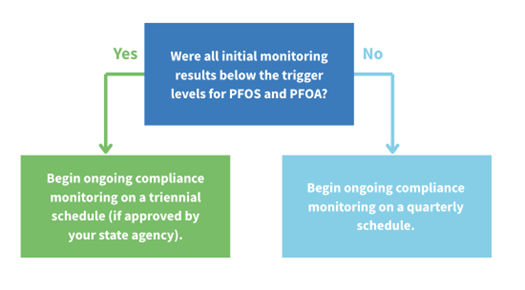
Compliance monitoring schedule flowchart
PFAS funding and support
EPA recently announced an additional $1 billion in funding for the Emerging Contaminants in Small or Disadvantaged Communities Grant program, which provides funding to eligible systems to identify sources of PFAS contamination, treat the contamination, and destroy the removed chemicals. This adds to the $5 billion that the Infrastructure Investment and Jobs Act (IIJA) provided to State Revolving Fund programs to address emerging contaminants including PFAS.
In addition, beginning this summer, EPA’s PFAS OUTreach (PFAS OUT) initiative will start proactively reaching out to water systems with elevated PFAS levels (greater than 4 parts per trillion), as reported in drinking water monitoring data submitted to EPA through the Unregulated Contaminant Monitoring Rule, as well as state, Tribal and territorial data sources. This program will direct systems to services and information to help them comply with PFAS regulations; resources will focus on treatment technologies, monitoring and rule implementation guidance, financial assistance, and case studies of contamination treatment and mitigation.
Commitment to transparency and safe drinking water
Monitoring for and treating PFAS is not just about complying with new federal regulations; it’s an essential step in ensuring safe drinking water for current customers and for generations to come. EPA expects that the NPDWR will prevent PFAS exposure in drinking water for approximately 100 million people, prevent thousands of deaths, and reduce tens of thousands of serious PFAS-attributable illnesses. By regularly testing for PFAS and communicating openly with customers, water systems are demonstrating their commitment to transparency and to safeguarding the health of our shared water resources.