
Small and rural water system operators across the United States serve as the frontline guardians of public health, often with limited staff and budgets. When water quality issues or violations happen, the federal Public Notification Rule under the Safe Drinking Water Act requires timely, clear communication to protect customers and maintain trust.
The 3 Tiers of Public Notification
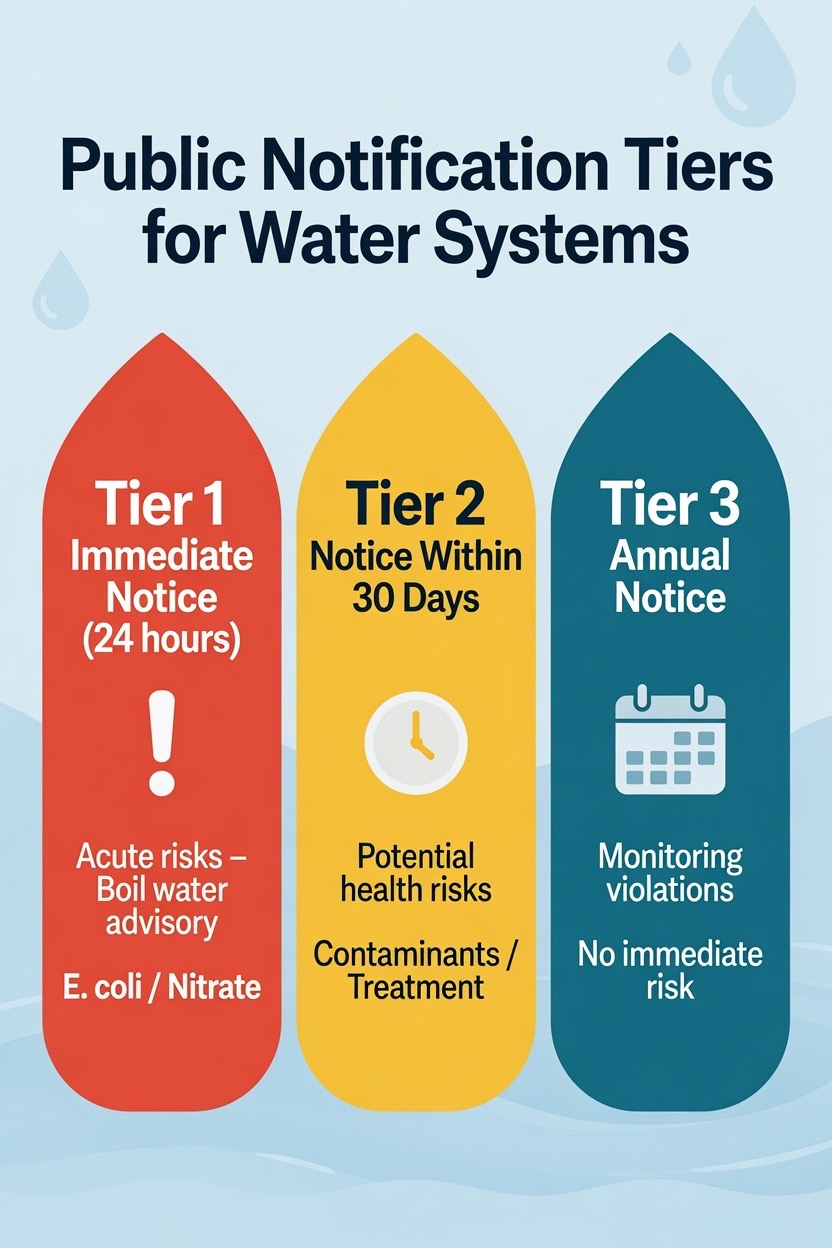
The EPA classifies notices by potential health risk.
Tier 1 (Immediate Risk) For situations with significant potential for serious short term health effects, such as E. coli violations, nitrate or lead action exceedances, and certain turbidity issues. Notify customers as soon as possible, but no later than 24 hours.
Tier 2 (Potential Adverse Effects) Most maximum contaminant level ‘MCL’, treatment technique, or monitoring violations with possible health impacts. Notify within 30 days, with possible repeat notices.
Tier 3 (Lower Risk) Monitoring, reporting, or minor violations. Notify within 12 months, often included in the annual Consumer Confidence Report ‘CCR’.
Every notice must include required elements;
- A clear description of the violation,
- Contamination levels,
- Mandatory health effects language,
- Population at risk,
- Corrective actions, and
- System contact information.
When notifying your community about a water quality issue or violation, keep these principles in mind:
Try to use plain, non-technical language.
Effective communication builds stronger community relationships.
Be honest and understanding.
Explain what happened, why it matters, what you are doing to fix it and what residents should/could do. For example, boil water, flush lines, and if possible water restrictions and lost or lower water pressure might occur.
Deliver multiple notices.
Mail or hand deliver with bills, post at public locations (libraries, post offices, churches or stores), use local radio, and social media. Provide bilingual notices where needed.
Document everything.
Keep records, photos of postings, and any delivery logs for state inspections.
Build year-round trust.
Share positive updates through newsletters or social media about maintenance, testing results and upgrades. This makes crisis communication easier.
In rural areas, where operators often know customers personally, proactive outreach prevents panic, speculation and can support rate increases or funding requests for infrastructure improvements. Strong communication turns regulatory requirements into opportunities to strengthen community support.
New Mexico Specific Requirements
In New Mexico, systems must submit a Public Notification Certification Form plus a copy of the notice to the NMED Drinking Water Bureau within certain time of delivery. When systems report their water issue to NMED, they will be advised on all dates of compliance, including how long to post notices and where to send all incoming lab results.
Systems must continue issuing notices until the issue is resolved. This is the case for all tiers.
Community systems must mail or hand deliver notices. Use additional methods to reach everyone.
Annual CCRs are due July 1.
Failure to notify properly can trigger extra violations and enforcement. Many small systems serve populations, including rural, low income and tribal communities. NMED has increased focus on compliance and recent statewide enforcement actions highlight prioritizing compliance to protect public health.