
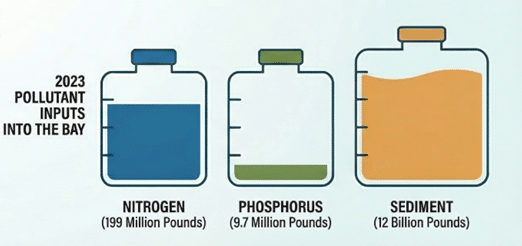
You may have heard about the Chesapeake Bay (the Bay), the largest estuary in the United States, which drains 64,000 square miles across six eastern states and the District of Columbia. It is a biodiversity hotspot home to 3,600 species of plants and animals and the world’s largest producer of blue crabs. It is a treasured resource for 18 million people and an economic engine for the Bay States, especially Maryland. The lands and waters of the Chesapeake Bay watershed provide more than $100 billion in economic benefit alone. However, the Bay faces stressors from urban and agricultural runoff, which carries excess nitrogen, phosphorus, and sediment from farms and cities. This pollution has impacted Bay’s aquatic life, fueled algal blooms, and degraded the water quality.
You may not have heard about the Chesapeake Bay Watershed Agreement: one of the most coordinated regional environmental efforts in the United States. It is a voluntary agreement that brings local, state, and federal leaders together with the goals to make it economically and environmentally sustainable. The Bay partners commit to restoring and conserving the Bay
History of Chesapeake Bay Watershed Agreements and Key Achievements
Chesapeake Bay has been governed by a series of voluntary agreements dating back to 1983. The agreement established the Chesapeake Bay Program Office (CBPO), a robust scientific and coordination unit under the Environmental Protection Agency that provides cohesive management and planning. Since the first agreement, subsequent agreements have grown in scope and ambition. To translate ambitious goals into action on the ground, the partnership relies on the 2010 regulatory framework and total maximum daily loads (TMDLs). The Bay TMDL is the only one of its kind that places limits on Bay water quality by integrating the pollution loads from over 100,000 tributaries.
The most recent agreement in 2025 focuses on 4 Interconnected goals and 21 outcomes of watershed restoration on Thriving Habitat, Fisheries & Wildlife, Healthy Landscapes, Clean Water and Engaged Communities. This is the first agreement to formally integrate the leadership of six federally recognized Indigenous tribes in Virginia. The clean water goal also supports the Clean Water Act by implementing BMPs and maintaining practices and controls to reduce nitrogen, phosphorus, and sediment loads.
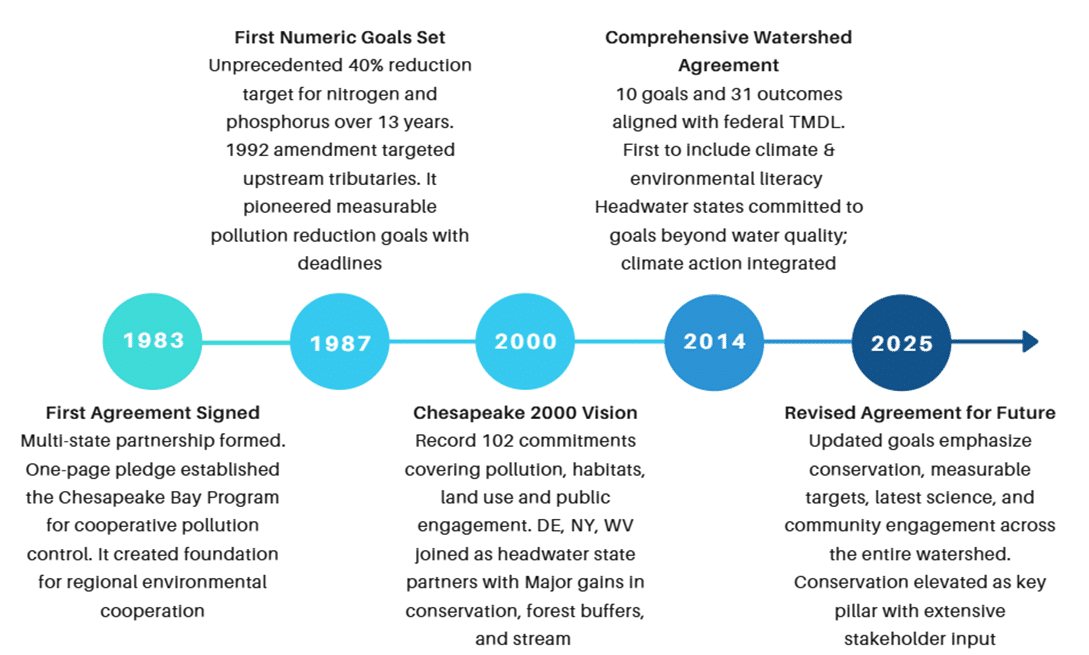
The new agreement, signed in 2025, also tackles the emerging contaminants and aims to reduce the amount and effect of these contaminants, such as PCBs, plastics, mercury, and PFAS, on the bay ecosystem. The CBPO will implement programs and grant funding to increase understanding, information sharing, and collaboration among the stakeholders in the Chesapeake Bay Watershed.
Chesapeake Bay Watershed Agreement and Total Daily Maximum Load (TMDL)
The Chesapeake Watershed Agreement is implemented mainly by Total Daily Maximum Load (TMDL). TMDL is used in different settings, as it usually drives the regulatory discharge limits in the National Pollutant Discharge Elimination System permits. Think of a TMDL as a science-based “pollution diet” or budget that allocates the maximum pollution. Each sector (wastewater treatment plants, agriculture) can contribute and serve as targets to restore impaired water bodies to meet water quality standards. In the context of Chesapeake Bay, it was established by EPA on December 29, 2010 and works as the legal backbone of the Bay restoration effort. TMDLs are limits to how much nitrogen, phosphorus, and sediment the Bay and its tributaries can absorb while still supporting aquatic life and human health. The TMDL identified the maximum amount of pollution the Bay can receive and still meet water quality standards. The Bay-wide annual targets set in the TMDL were:
- 185.9 million pounds of nitrogen (a 25% reduction from 2009 levels)
- 12.5 million pounds of phosphorus (a 24% reduction)
- 6.45 billion pounds of sediment (a 20% reduction)
Each jurisdiction turns these limits into Watershed Implementation Plans (WIPs) with two-year milestone commitments. This leads to TMDL requirements in individual NPDES permits where operators and engineers aim to achieve those in the effluent limits for nitrogen, phosphorus, and sometimes sediment.
Progress on the Chesapeake Bay Watershed Agreement
Chesapeake Bay water quality data from 2014–2023 indicates mixed trends, with approximately 43% of monitoring stations showing improved nitrogen levels while 39% are not showing improvement. Phosphorus trends are more concerning, with 47% of stations not improving compared to 24% improving. The biggest win was in the wastewater sector, decreasing annual nitrogen levels from 56 million to 27 million pounds by 2024, primarily through improvements in wastewater treatment plants. However, nitrogen pollution from septic systems rose, now releasing approximately 7.8 million pounds per year, an increase of over 200,000 pounds since 2010.
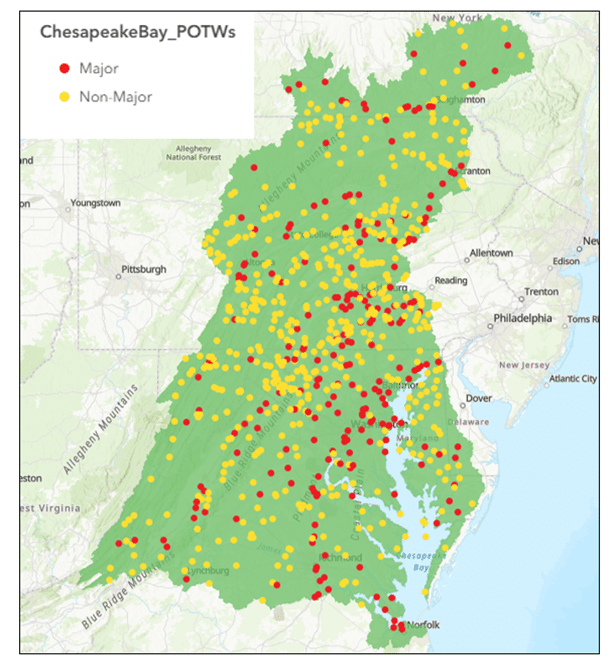
As the wastewater (point source) loads are already largely controlled, the Chesapeake Bay Program has shifted its primary focus to nonpoint sources, such as agricultural and urban runoff. Stormwater and agricultural runoff are among the few pollution sources still on the rise, and over 50 million pounds of nitrogen still need to be cut from these sources alone to meet current targets. It has taken over a decade to generate less than six million pounds of non-point-source reductions. Best management practices already in place are expected to reduce approximately 27 million pounds of nitrogen and 4 million pounds of phosphorus annually, but ecosystems take time to recover. Science and monitoring indicate that land-use changes to reduce runoff take time to be observed in Bay water quality and habitat improvements. New modeling focuses on addressing non-point source pollution and warming waters driven by climate change. There are concerns that climate change may impact progress and could make restoration gains more difficult if left unaddressed.
Conclusion
Across its 64,000-square-mile watershed, the Chesapeake Bay Agreement delivers substantial results in meeting key TMDL targets, particularly from wastewater treatment plants, and proves that regional partnerships can drive measurable environmental change. The path forward runs through the same formula that worked for wastewater with clear targets, accountability, funding, and innovation. Continued progress is now aimed at non-point sources and incorporating climate concerns to achieve bay-wide pollution reduction goals.