
What is Asset Management?
What is the number one reason why utilities exist? It is to serve their customers. What is the number one reason they should take on asset management? To better serve their customers. Whether or not a utility undertakes asset management, it is doing activities every day to provide drinking water to customers or treat wastewater coming from customer homes. Asset management provides a framework to help utilities meet customer expectations in the most efficient, cost-effective way.
The simple definition of asset management is: “meeting the desired level of service at the lowest life-cycle cost.” The first part of the definition, “desired level of service”, is the idea that utilities exist to serve their customers. The second part of the definition, “lowest life-cycle cost”, is the idea that asset management helps utilities better serve their customers.
Asset management consists of five core components (see Figure 1):
1) Level of Service (Yellow):
Understanding the level of service your customers desire. Setting goals around the desired level of service. Collecting data to be able to measure whether goals are met and then measuring the goals and reporting on how well the system is doing towards meeting the goals. Examining actions to improve progress towards meeting goals.
2) Current State of the Assets (Blue):
Determining what assets you have to provide the level of service, including where they are located and the information you want to know about them. Placing the information about the assets and their associated attributes into an asset inventory or asset registry. Creating a map to show where assets are located to make it easy to find them.
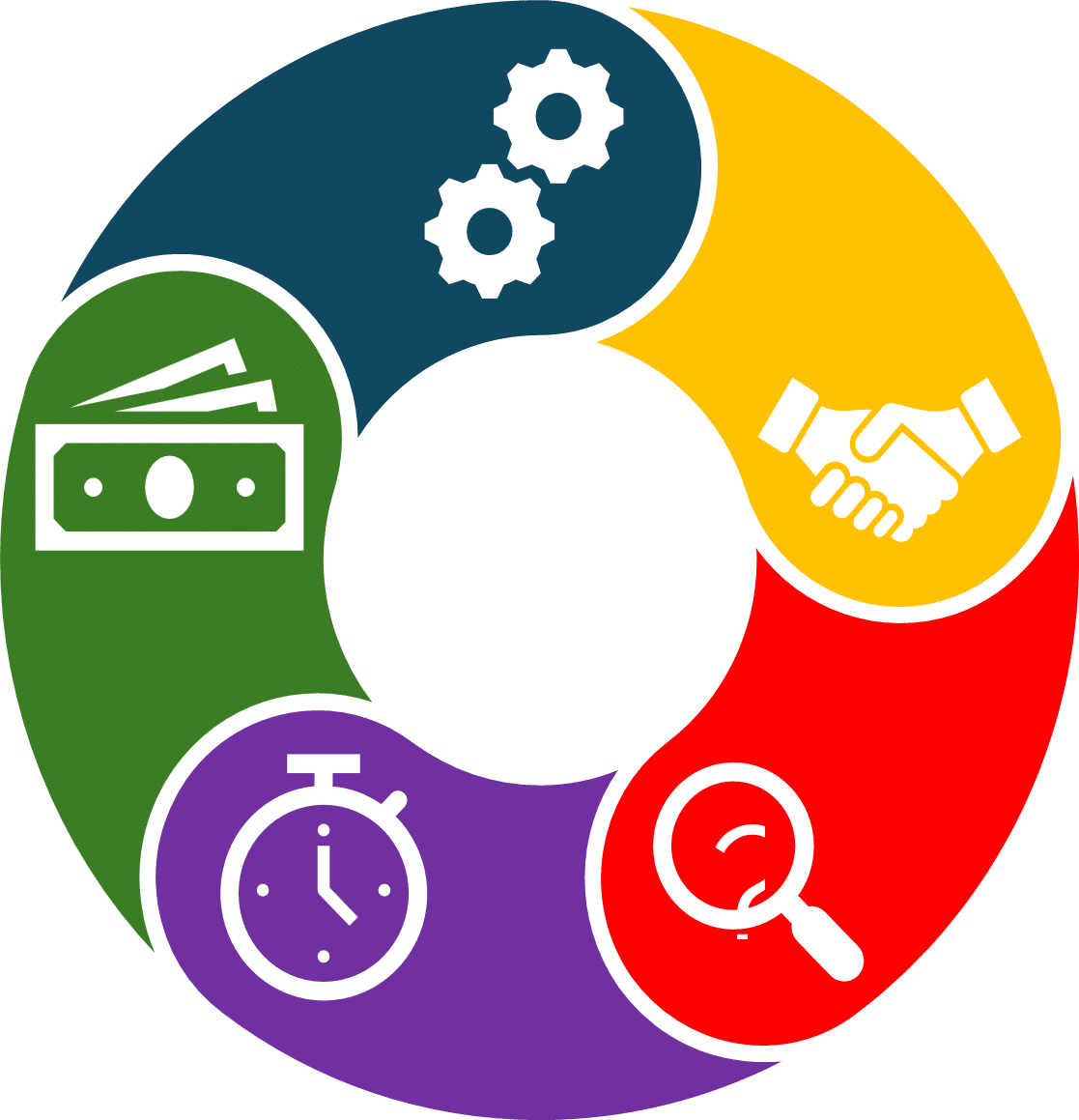
3) Criticality (Red):
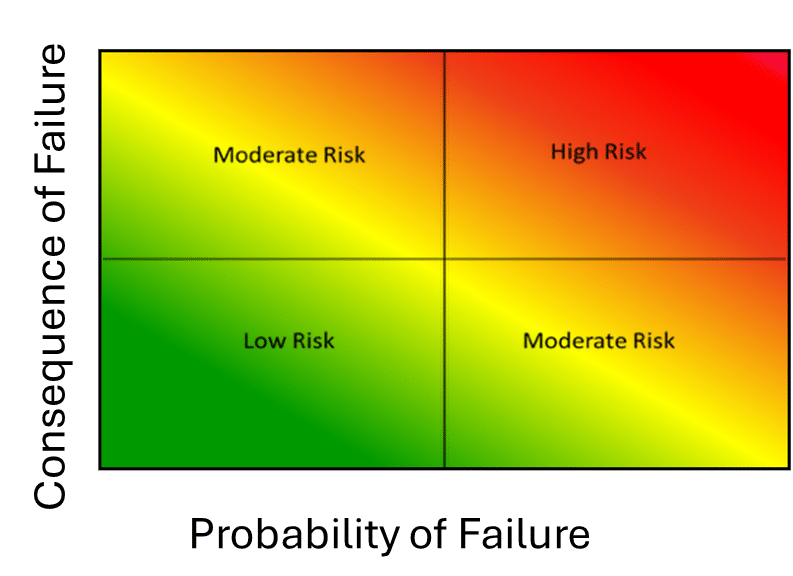
Understanding which assets are most critical to delivering the service. It answers two questions: what is the likelihood that any individual asset will fail and what is the consequence if the asset does fail. The likelihood of failure and consequence of failure are ranked from 1 to 5 (or some other set of numbers, if a different range is desired) with 1 being very low and 5 being very high. Then the two numbers are multiplied together to calculate risk. If a 1 to 5 scale is used, the risk will range from 1 to 25. It can be plotted on a graph similar to Figure 2 that can show the criticality of one asset compared to another.
4) Life-Cycle Costing (Purple):
Considering the entire life cycle of an asset and the interventions that are necessary during each stage of the asset’s life to get the longest life span out of the asset and to operate most efficiently. It is important to remember that the asset’s life starts in the planning stage. At this stage, a utility has the most influence at the least cost. As the assets move through design, the influence drops and the costs increase until the lines cross over at construction. At this point, the costs increase tremendously and the influence over the project drops. Once the assets move into the operations stage, the influence a utility has over the assets is very low and the costs are very high. Therefore, it is imperative that full consideration of operations takes place in the planning and design phases to ensure that the project will best meet the community’s needs.
5) Long-Term Funding (Green):
Calculating the full costs of operations so that they may be paid for by charging adequate rates of the system’s customers. Creating a budget that addresses the needs of the system and checking it against actual expenditures. Developing short- (10 years or less) and long-term (50 to 100 years) capital improvement plans for assets. Ensuring that the utility can be funded sustainably for the long term.
Why Should I Want to Implement Asset Management?
We should implement asset management activities and programs because of the benefits they can provide. There are numerous benefits, but a few are presented below.
- Being able to align the services your utility is providing with the level of service desired by the customers. When these service levels are not in alignment, systems may not be expending funds in the right places. Aligning these levels also helps ensure customers understand what they are paying for and are willing to pay the rates required to receive this service.
- Understanding what assets the utility owns, information about them, and where they are located so that other activities can be done more effectively and efficiently. For example, finding assets quickly and easily for operations, maintenance, and corrective actions; sharing asset information between all staff members to improve knowledge and support succession planning; and, improving maintenance activities.
- Using risk to determine the optimal time and approach to repair, rehabilitate, and replace assets and the best way to perform routine, preventative, and predictive maintenance. Investing time and money to reduce risk and prevent severe consequences from happening. Conducting activities prior to severe consequences saves money and improves operator safety.
- Moving from reactive to proactive work. When activities are mostly reactive, operators are moving from one emergency to the next and it is extremely difficult to address assets that are not completely broken down. In reactive mode, the operator’s job can feel very frustrating—days cannot be planned effectively, and costs are much higher. Additionally, operator safety can be compromised because working in emergency mode reduces the time available to plan for activities and address safety concerns and there is a desire to complete activities quickly which can also reduce safety considerations.
- Improving maintenance by tracking maintenance activities, optimizing their timing, and understanding whether the maintenance activities (their timing and their approach) are reducing the number of failures and increasing asset life.
- Helping to reduce the gap between the money that is actually available and the money needed to do all the activities that the operators, managers, decision-makers, and elected officials would like to do on the system. By understanding the needs of the system, optimizing activities through the other 4 components of asset management (not including long-term funding), and communicating the need for and implementing necessary rate increases the gap can be reduced, perhaps significantly so.
These and other benefits fall into three categories – financial, environmental, and social. These three categories, collectively, are referred to as the triple bottom line. Financial benefits are related to money, including potential cost savings or cost avoidance from completing activities in a more efficient manner. Environmental benefits include activities that would reduce the use of natural resources, improved energy efficiency, reduction in waste produced, regulatory compliance improvements, and anything else that would protect the environment. Social benefits refer to those benefits that accrue to people. The people category includes customers, elected leaders/owners/final decision-makers, and staff. It is extremely important to consider how asset management can benefit staff and seek these particular benefits because they will extend to customers and elected leaders. Asset management can help staff solve problems they are experiencing which in turn helps the system better serve its customers.
How does Asset Management tie to funding a project?
Asset management is an important activity for any utility (water, wastewater, stormwater) to undertake. It provides numerous benefits as previously discussed. You might be thinking, ‘What does this have to do with seeking funding from the State Revolving Fund, or any other state or federal funder?’ In some cases, the federal or state funding agencies may require an asset management plan (or a fiscal sustainability plan, which is very similar) and you won’t receive the funding if you don’t undertake an asset management program. In other cases, they may provide incentives to complete an asset management program. These incentives may move your utility up on the priority list and ensure it receives the funding it needs.
These agencies want utilities to take on asset management because when they do, the funders can have more assurance that the future assets will be well cared for. They do not want to provide funds, especially grant funds, if the utility will defer maintenance and allow the assets to decay at a much faster rate than if they were well cared for. It is more efficient for everyone – utility, funder, customers – if a robust asset management program is developed and implemented.
An Asset Management Plan vs. Implementation of Asset Management
Often funding agencies require a utility to submit an Asset Management Plan (AMP) to show proof of asset management. These plans may be developed by a third party, sometimes the engineer who developed the Preliminary Engineering Report, or the one doing the design of the new facility. There is a temptation to turn over the entire process to this third party and not get involved. Furthermore, a utility may wish to set the AMP on a shelf and forget about it.
A utility should avoid these temptations. It is important to recognize that a utility will only receive benefits if it actually implements asset management. The AMP can outline how to implement the activities, but the utility must take action itself. The AMP and associated asset management activities will best benefit the utility if it fully participates with the third party who helps to develop the plan.
How can I get help to develop an asset management program?
There is a lot of help available to get started on asset management and the creation of an asset management plan. The Environmental Finance Center Network has free technical assistance available for drinking water systems with populations under 10,000 and wastewater systems under 1 Million Gallons per Day of flow. These services are nationwide. They can be requested by completing a very simple form that can be found here. We also provide free in-person and remote trainings on asset management. A list of upcoming trainings can be found on the EFCN Website. Recorded webinars can be found on our Youtube channel.
There are also many free resources to help a utility if it wishes to develop an asset management plan on its own. A very comprehensive guide to asset management was created by the Southwest Environmental Finance Center (Southwest EFC), the Integrated Asset Management Framework, and is available free to anyone. Additional resources can be found on the EFCN website and the Southwest EFC website.
Additionally, funders may have money available to pay for the development of all or part of an asset management program.
Conclusion
Asset management is an important activity for any drinking water, wastewater, or stormwater utility to undertake. It provides significant benefits to the utility and by extension, the funders who are providing financial resources for asset rehabilitation and replacement. All utilities should have an implemented asset management program. Help is available, free to any eligible entity, to develop a program.