

Small water systems play a crucial role, serving millions of people across rural and suburban communities in the U.S. These systems consistently face pressures from aging infrastructure, limited staffing, and rising regulatory demands. As digital technologies advance, Artificial Intelligence (AI) is emerging as a promising tool to help small systems operate more efficiently and sustainably, yet AI also brings real challenges that must be navigated carefully.
In this blog, we provide an overview of the opportunities and challenges of AI, grounded in reliable research and federal guidance, to help small utilities consider where AI might fit into their future planning.
I. Opportunities: How Can AI Support Small Water Systems? And To What Extent?
I.1. Enhanced Monitoring and Leak Detection
AI paired with smart meters and pressure/flow sensors can provide near-real-time insights into system performance. Machine-learning models detect anomalies—such as sudden drops in pressure or unexpected increases in flow—that may indicate leaks or unauthorized use.
- The U.S. Environmental Protection Agency (EPA) emphasizes that improved data analytics and digital tools can significantly strengthen small-system resilience and operational efficiency.[1]
- Academic studies show that machine learning-based leak detection algorithms can outperform traditional threshold methods, reducing non-revenue water losses.[2]
I.2. Predictive Maintenance and Asset Management
AI can help forecast equipment failures, estimate remaining useful life of pumps or valves, and prioritize maintenance. This reduces emergency repairs and stretches tight budgets.
Predictive models have demonstrated success in anticipating failures in water treatment and distribution components, allowing utilities to shift from reactive repairs to planned maintenance.[3]
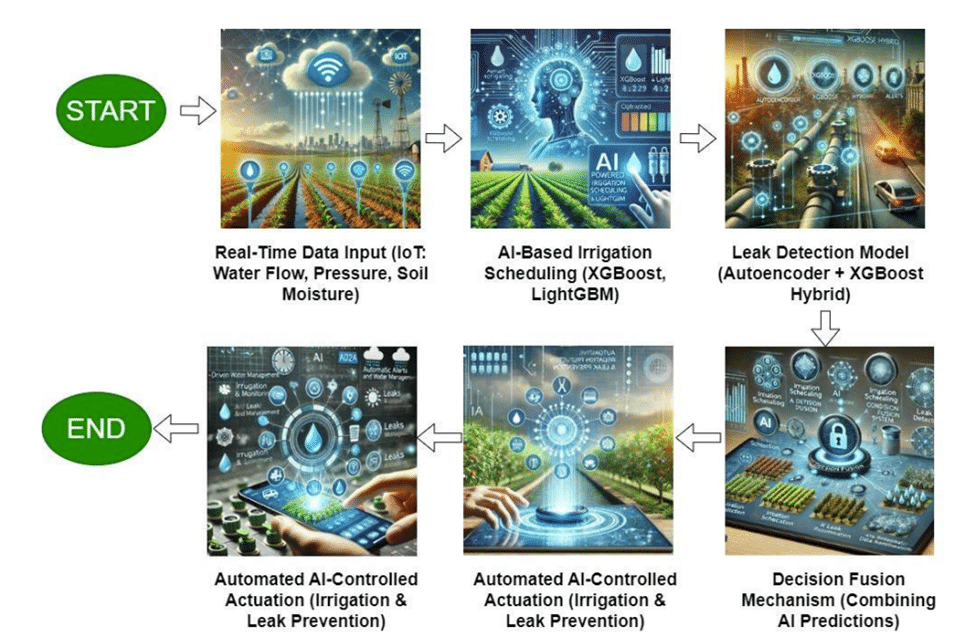
Figure 1: An AI-powered irrigation system utilizing IoT data, AI-based scheduling, leak detection, decision fusion, and automated actuation to optimize water management and prevent leaks.[4]
I.3. Better Demand Forecasting and Energy Optimization
AI can analyze historical usage, weather, and demographic patterns to forecast demand more accurately. This helps operators schedule pumping during low-energy-cost periods, reduce over-treatment or under-supply, and plan for seasonal or drought-related fluctuations.
Research shows machine learning-based demand forecasting can significantly improve efficiency for small systems with limited operational flexibility.[5]
I.4. Water Quality and Wastewater Treatment Optimization
AI is increasingly used in treatment process control—predicting contaminant loads, adjusting chemical doses, optimizing aeration, and improving biological treatment. A 2025 review in Journal of Environmental Management found that AI can enhance water reuse and wastewater treatment performance, though scaling remains challenging.
I.5. Regulatory Compliance and Reporting
AI can automate elements of data compilation, reporting, and trend analysis, reducing administrative burden for utilities with few staff. The EPA has highlighted digital compliance tools as a pathway for small systems to meet Safe Drinking Water Act requirements more efficiently.
II. Challenges: What Makes AI Adoption Difficult for Small Systems
II.1. Data Gaps and Aging Infrastructure
AI depends on high-quality data. Many small utilities lack the sensors, SCADA (Supervisory Control and Data Acquisition) systems, or digital meters required to generate it. Legacy infrastructure presents a major barrier, and retrofits can be costly.[6]
II.2. Limited Technical Expertise
Many small systems operate with minimal staff, who already juggle multiple roles. AI implementation requires data management, cybersecurity practices, understanding model behavior, and ongoing monitoring.
Research from Virginia Tech notes that utilities frequently “lack in-house AI expertise,” increasing dependence on external vendors, which can limit transparency and trust.[7]
II.3. Upfront Costs and Funding Constraints
Although AI may produce long-term savings, the initial costs of sensors, software, staff training, and IT infrastructure can be prohibitive. Small systems often struggle to access capital compared to larger utilities.
The EPA’s Small System Drinking Water Workshops highlight funding constraints as one of the top barriers to adopting advanced technologies.
II.4. Trust, Transparency, and Regulatory Considerations
AI models—especially deep learning—can act as “black boxes,” producing outputs that are difficult for operators or regulators to interpret.
Regulators increasingly expect transparency in how operational decisions are made. AI tools must be explainable and auditable to fit within compliance frameworks—an ongoing challenge noted in multiple academic reviews.
II.5. Validation and Scalability
Although many AI solutions are tested successfully in research environments, real-world systems vary widely in data availability, infrastructure, and staffing. Peer-reviewed studies note that scaling AI from pilot projects to live deployment still faces validation challenges.
III. Current Research and Guidance Supporting Small Utilities
Several initiatives are emerging to help small utilities adopt AI more responsibly:
- The Water Research Foundation (WRF) is developing an AI Guidebook for Water Resources Planning, providing structured guidance for utilities of all sizes.[8]
- EPA technical assistance programs continue to explore digital tools for small systems, focusing on resilience, monitoring, and operations.
- Academic research is proposing frameworks (e.g., aiWATERS from Virginia Tech) outlining data readiness, governance, transparency, and sustainability pillars for AI adoption in water utilities.
These efforts signal increasing institutional support for AI adoption in the water sector.
IV. Practical Recommendations for Small Systems
If your system is beginning to explore AI, consider the following steps:
- Start with small, high-value pilots such as leak detection or demand forecasting.
- Invest in foundational data infrastructure—sensors, telemetry, and secure data storage.
- Build internal capacity gradually through training and partnerships with universities or regional technical assistance providers.
- Assess costs versus long-term benefits with a clear understanding of staffing and operational needs.
- Prioritize transparency and explainability to maintain regulatory compliance and public trust.
- Leverage external funding from SRF programs, WRF research partnerships, and federal resilience grants.
Conclusion
AI holds tremendous promises for small water systems seeking to enhance reliability, efficiency, and water quality. But realizing these benefits requires thoughtful, incremental implementation supported by strong data, transparent governance, and sustained staff capacity.
With federal agencies and research institutions increasingly focused on AI in the water sector, small systems now have a growing toolbox of resources to help integrate AI safely and effectively—ensuring they are better prepared for the challenges ahead.
Helpful Resources:
https://www.epa.gov/water-research/small-drinking-water-systems-webinar-series
Sources
[1] https://www.epa.gov/water-research/past-webinars-small-drinking-water-systems-series?utm_source=chatgpt.com
[2] Medeiros, V. d. S., dos Santos, M. D., & Brito, A. V. (2024). Case Study for Predicting Failures in Water Supply Networks Using Neural Networks. Water, 16(10), 1455. https://doi.org/10.3390/w16101455
[3] Asadi, Y. Employing machine learning in water infrastructure management: predicting pipeline failures for improved maintenance and sustainable operations. Industrial Artificial Intelligence 2, 8 (2024). https://doi.org/10.1007/s44244-024-00022-w
[4] Source: M. B. R. Mahmoud et al., “Optimized AI and IoT-Driven Framework for Intelligent Water Resource Management,” in IEEE Access, vol. 13, pp. 97628-97646, 2025, doi: 10.1109/ACCESS.2025.3572067.
[5] Liu, G., Savić, D., & Fu, G. (2023). Short-term water demand forecasting using data-centric machine learning approaches. Journal of Hydroinformatics, 25(3), 895–911. https://doi.org/10.2166/hydro.2023.163
[6] Idrica. (2024, March 6). Protecting the planet: The technological trends shaping water management in 2024. Idrica. https://www.idrica.com/blog/water-technology-trends-2024/
[7] Vekaria, D. T. (2023). aiWATERS: An artificial intelligence framework for the water sector (Master’s thesis, Virginia Tech). Virginia Tech VTechWorks. https://vtechworks.lib.vt.edu/handle/10919/115799
[8] The Water Research Foundation. (2025, November 20). The emergence of AI in the water sector: Opportunities and challenges for water resources planning (Project information summary). https://www.waterrf.org/resource/emergence-ai-water-sector-opportunities-and-challenges-water-resources-planning