

If you are running a small water or wastewater system, evaluating your rate structure on an annual basis is a best practice. By reviewing its financial goals, rate structure, and budget each year, a system’s leadership can better assess if financial needs are being met or if changes must be made.
Understanding Your Water System’s Goals and Priorities
Every public water and wastewater system has competing obligations it must prioritize in order to effectively run itself as a business while simultaneously striving to maintain affordability for customers. With a requirement to protect public health, systems must charge a sufficient rate to cover all costs of providing water service, including treatment, operations, maintenance, repairs/replacements, and personnel. It also has to determine how other values, such as water conservation, economic development, and affordability for various classes of customers should be considered. And finally, a water or wastewater system must plan for tomorrow, putting away savings that can help with both planned and emergency expenses necessary to maintain or improve service. Without savvy financial planning, broken equipment can cause a public health crisis.
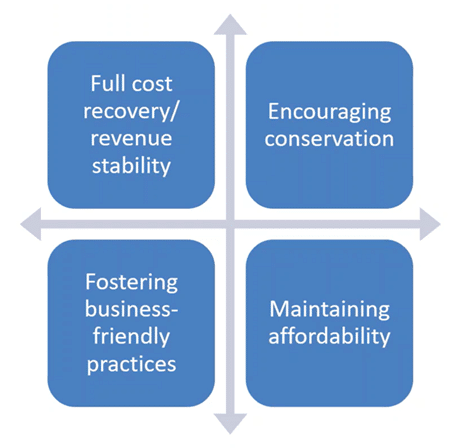
Rates can be set in a variety of ways to encourage different values, goals, and priorities. However, setting a rate to promote one goal may be in direct conflict with another so it is very important to determine which goals are most desired by the elected leaders and community. The chart above shows four common objectives that a utility can review and choose the appropriate priority order.
Understanding Your Rate Structure: Water Systems
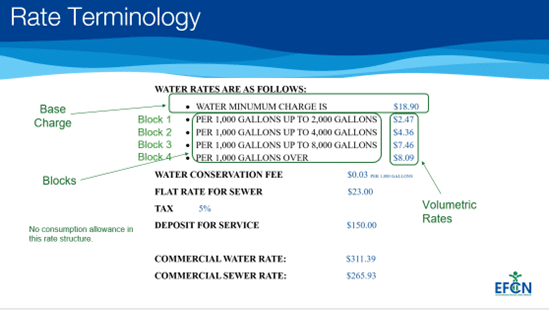
Unless your system is brand new, it is already charging customers for drinking water and/or wastewater services, using a variety of factors to determine rates. Your rate structure—the implementation of how those charges are determined—should be publicly available and reviewed at least annually. Historically, many small water systems implemented a rate structure that charged just a fixed or flat fee for water, which was independent from a customer’s usage. While convenient for accounting, this type of rate structure is not necessarily equitable because all users will pay the same rate regardless of usage and low volume users will be subsidizing high volume users. This structure is not necessarily able to address affordability issues or promote water conservation measures, but prioritizing these objectives requires household meters.
With individual meters, it is possible to measure the amount of water each customer uses, then the rates can include a portion for volumetric pricing, in which charges are allocated based on consumption. Using volumetric charges means that both the utility and the customer are informed about how much water is used, which can influence customer behavior and encourage conservation.
For households who struggle with paying utility bills, volumetric pricing also allows costs to be distributed based on consumption, allowing customers to potentially save money through reductions in their usage. Many utilities who use volumetric charges still include a base charge, which is the minimum amount paid by a customer regardless of their usage. They may also have a consumption allowance, in which customers receive a set amount of water with the base bill and only pay a volumetric fee if they go over the allocation. For example, if the base bill includes 3,000 gallons/month, a customer using only 2,500 gallons would pay only the base bill or minimum charge. However, using allocations can discourage customers from using less than the allocated amount, which is a negative result if the system is seeking conservation. This concern is especially true if the utility has a high allocation in the base bill.
For systems incorporating volumetric charges into their rate structure, there are three additional ways to charge based on volume: a uniform rate, a decreasing block rate, or an increasing block rate. In a uniform rate, the amount charged for each unit of water (often in thousand-gallon increments) stays the same, regardless of the total water used. In contrast, both increasing and decreasing block rates change the price of water based on how much is used. In an increasing block rate structure, the unit price of water increases the more water a customer uses. In a decreasing block rate structure, the opposite occurs. For systems attempting to encourage conservation, an increasing block rate incentivizes low water usage, as high usage customers are penalized monetarily the more water they consume. This is common in water-scarce communities who have concerns about long-term supply. In contrast, if a community is attempting to encourage growth of water-dependent businesses, a decreasing block structure would make water cheaper per unit the more a customer uses.
Beyond the rate structure for base and volumetric charges, water systems must also consider if other costs should be accounted for elsewhere. Taxes, conservation fees, and other ancillary charges should also be acknowledged in a system’s rate structure. If a community provides drinking water or wastewater to different types of customers, having different rates for each class of customers is also appropriate, particularly if some of those customers require larger capacity distribution or collection lines. Evaluating how a system charges customers if they are single-family households, apartment complexes, or commercial enterprises is an additional factor drinking water and wastewater systems should consider when reviewing their rate structures.
Understanding Your Rate Structure: Wastewater Systems
IIf your community has both a drinking water and wastewater system, it is necessary to charge a separate fee to cover the costs of operating the wastewater facility and the collection system that brings the water to the treatment plant. While it is possible and common to meter water flow into a household, that is not true for wastewater leaving a household. Wastewater rates are most commonly either based on a flat rate (everyone pays the same) or drinking water usage.
For many systems, a flat charge for wastewater based on the type of connection (residential, commercial, industrial, etc.) is utilized. While simple to determine revenue, this structure again fails to account for customers creating more wastewater. This option is the only one available for systems without individual drinking water meters. Other options include charging customers based on their drinking water consumption levels, with the idea that the drinking water used in the household will become wastewater. However, some drinking water delivered to a household does not return to the system as wastewater but instead is used for purposes like gardening and watering lawns, and a small amount of what is used for laundry, cooking, and cleaning may not end up in the sewer. To account for these discrepancies, wastewater charges may be based on a percentage or portion of the drinking water usage or are based on an average of winter usage to remove outside summer watering.
As with drinking water rates, wastewater rates are the primary means by which a utility generates the funds needed to operate and maintain the system. One additional recommendation for utilities is to maintain separate accounts (an enterprise fund) for drinking water and wastewater, that separates these fees from all other community services or needs. An enterprise fund allows the system to better determine if the rates being charged–and revenue generated–indeed match the expenses for each component of the utility, or if some parts of the utility are underfunded and a rate increase may be necessary.
Understanding How Much Revenue Your Rates Generate
Once a system has reviewed how its rates are structured, evaluating how much overall revenue is generated each month and annually is the next step. If a volumetric rate is used, reviewing historical records of water consumption, along with a system’s expenses and revenue, can help illustrate how the amount of water used by customers has impacted the amount of revenue generated over time. Reviewing a system’s historical record of costs, can help drinking water and wastewater utilities project what usage trends might look like in the future. This review can help a utility to set its rates at appropriate levels to ensure full-cost recovery going forward.
For systems who may have financial records but are unsure how to best evaluate their budgetary needs, or for those who do not have good records, finding free support through technical assistance providers like the Environmental Finance Center Network (EFCN) is recommended. Resources like the UNC’s Water and Wastewater Rates Analysis Tool (used across the EFCN team) allow public utilities to incorporate water consumption and other demographics into rate structures, along with additional variables such as growth rate, uncollected bills, loans, and multiple rate classes and block rates, into their internal evaluation. If a system is unsure how best to evaluate its historic data to project future revenue, getting help from the EFCN is a great next step to take.
Conclusion
A water system’s rate structure is the means by which it generates the money needed to pay for its current expenses and save for future ones. If your water or wastewater utility has not reviewed its rate structure, financial goals, and budget in the past year, it is time to do so! Working with a technical assistance provider can help utilities get the additional expertise needed to make better long-term decisions for their community.
Read the next blog, How to Adjust Your Utility’s Water and Wastewater Rates, to learn more about how to adjust your rate structure to meet revenue needs.