
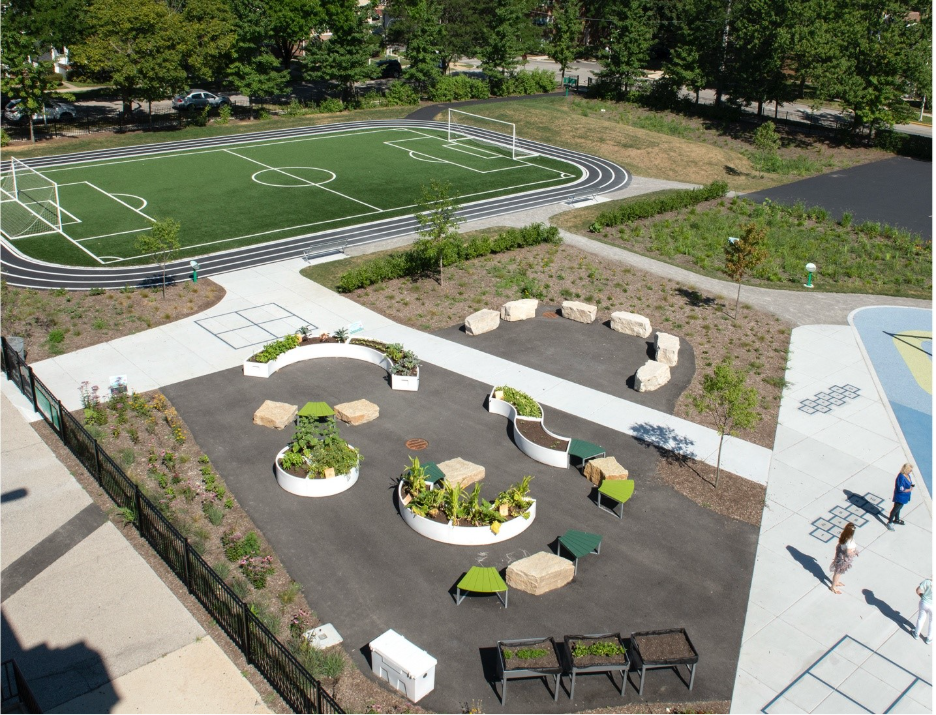
Photo Credit: MWRD / Space to Grow
Green schoolyards are proving to be one of the most versatile tools water and wastewater utilities can invest in – capturing stormwater where it falls while giving neighborhoods shade, play space and cooler summers. In the second and third installments of Greenprint’s three-part webinar series with the Environmental Finance Center Network, stormwater leaders from Milwaukee and Chicago shared how they fund these projects and what they have learned. For utilities weighing a similar strategy, a few takeaways stand out.
Schoolyards move real volumes of water
The Milwaukee Metropolitan Sewerage District (MMSD) is working toward a 2035 goal of capturing the first half-inch of every rainfall, about 740 million gallons, through green infrastructure, and green schoolyards now make up roughly 20% of that portfolio. In greater Chicago, the Metropolitan Water Reclamation District (MWRD) has built 41 schoolyards through its Space to Grow partnership since 2014, together storing 8.8 million gallons per storm. For agencies facing permit gallon goals or combined-sewer overflows, distributed sites like schools add capacity the big gray projects can’t reach alone.
Predictable funding beats one-off grants
Both districts stressed that sustainable programs need a reliable model, not a yearly scramble for dollars. MWRD built Space to Grow around a transparent formula: it and the city’s Department of Water Management each pay $5 per gallon stored, capped at 45% of construction costs and $5.3 million per partner annually. As MWRD’s Holly Sauter put it, “grants don’t solve funding problems”, a lasting program needs a committed, recurring partner. Milwaukee learned the same lesson the hard way, with schools once navigating a maze of separate programs before Milwaukee Public Schools (MPS) and MMSD moved toward a single, dependable funding stream.
Utilities pay for water; find funding for the playground
A utility can only fund the stormwater portion of a project, so other co-benefits – play structures, walking paths, turf and trees – require stacked funding. MPS has raised $35 million over seven years by layering grants, partnerships and modest school fundraising; individual projects have run from 70% to 96% grant-funded. In suburban Chicago, where districts sit outside their municipalities and lack built-in partners, teams are courting villages, businesses and capital budgets, and one district used a general obligation bond to cover its share. Budget for co-benefits early, and know which dollars can legally cover what.
Community engagement protects the investment
Both programs found that projects only last when they reflect what neighbors actually asked for. Chicago teams met early and often with students, teachers, parents and – critically – maintenance staff, designing schoolyards that they can realistically keep up. The green features can be integrated into classroom curriculum, providing learning opportunities for students. Keeping sites open after hours means they can double as community assets.
Plan for the long-term maintenance system
Milwaukee uses conservation easements requiring 11 to 20 years of upkeep and leans on partners to share the load, treating long-term stewardship, not construction, as the point where the investment is secured. Chicago learned it the harder way, maintenance was an early stumbling block for Space to Grow, and answered with capacity rather than cash alone: district-held maintenance contracts with green infrastructure-trained firms, caretaker training tied to project closeout and teacher professional development. For utilities, that argues for funding the stewardship system, not just a maintenance line item.
Key Takeaways
For utilities, the throughline is encouraging: green schoolyards can help meet regulatory goals while delivering the health, equity and climate benefits that communities and leadership value. The agencies furthest along didn’t wait for a perfect model, they piloted one, learned from it and kept improving.
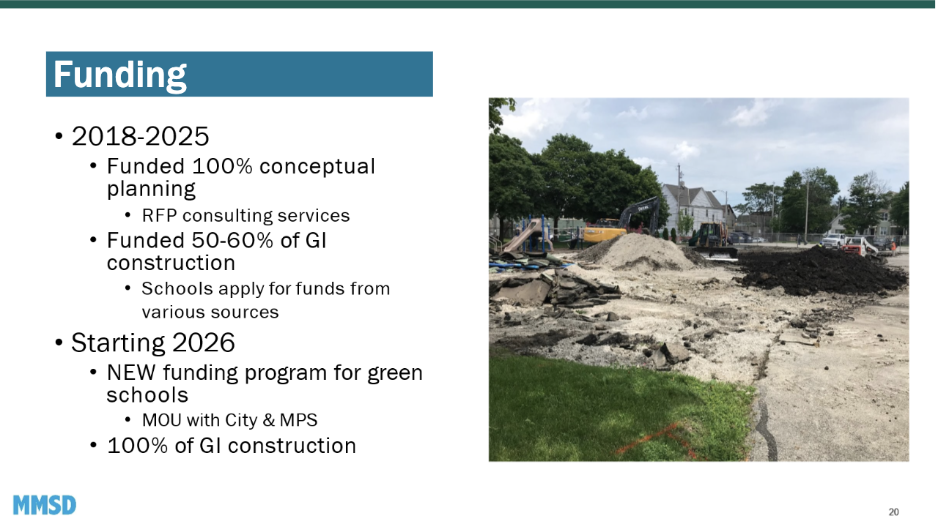
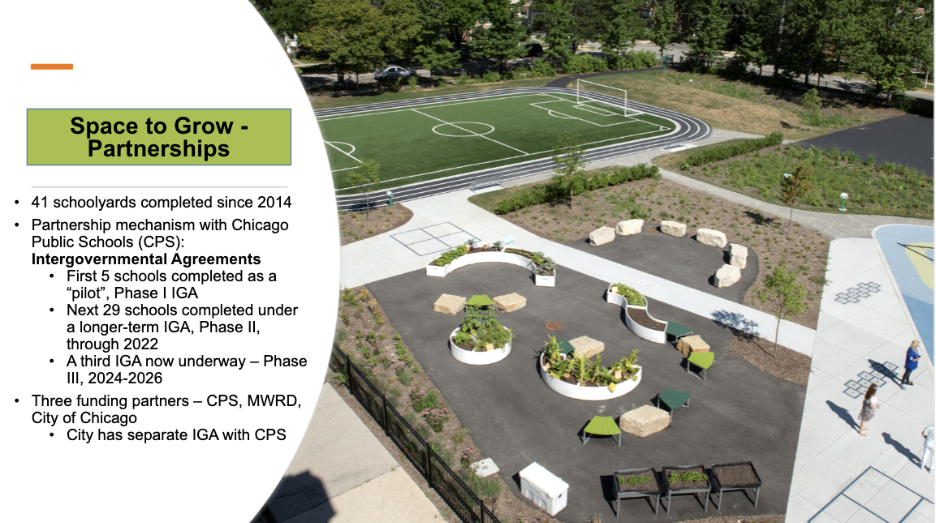
Both MMSD’s and MWRD’s programs have evolved over the years, starting with a pilot project or phase and iterating through subsequent phases. Photo Credit: MMSD (top) and MWRD (bottom)
Additional Resources:
Watch the Environmental Finance Center Network’s, “Green Schoolyards as a Stormwater and Community Resilience Strategy,” webinar series moderated by Greenprint Partners here: